

The Truth About Equalization in Freediving: Why Most Freedivers Struggle
If there is one question I answer more than any other as a freediving instructor, it’s this:
“Why can’t I equalize?”
Whether it’s a beginner struggling at three meters or an experienced diver trying to break through thirty, forty or even sixty meters, equalization is by far the biggest obstacle in freediving. The interesting thing is that most people assume they have a physical problem. In reality, they usually don’t.
After teaching hundreds of freedivers—from complete beginners to instructor candidates and competitive athletes—I’ve found that most equalization problems don’t come from your ears. They come from technique. And the good news is that technique can be learned.
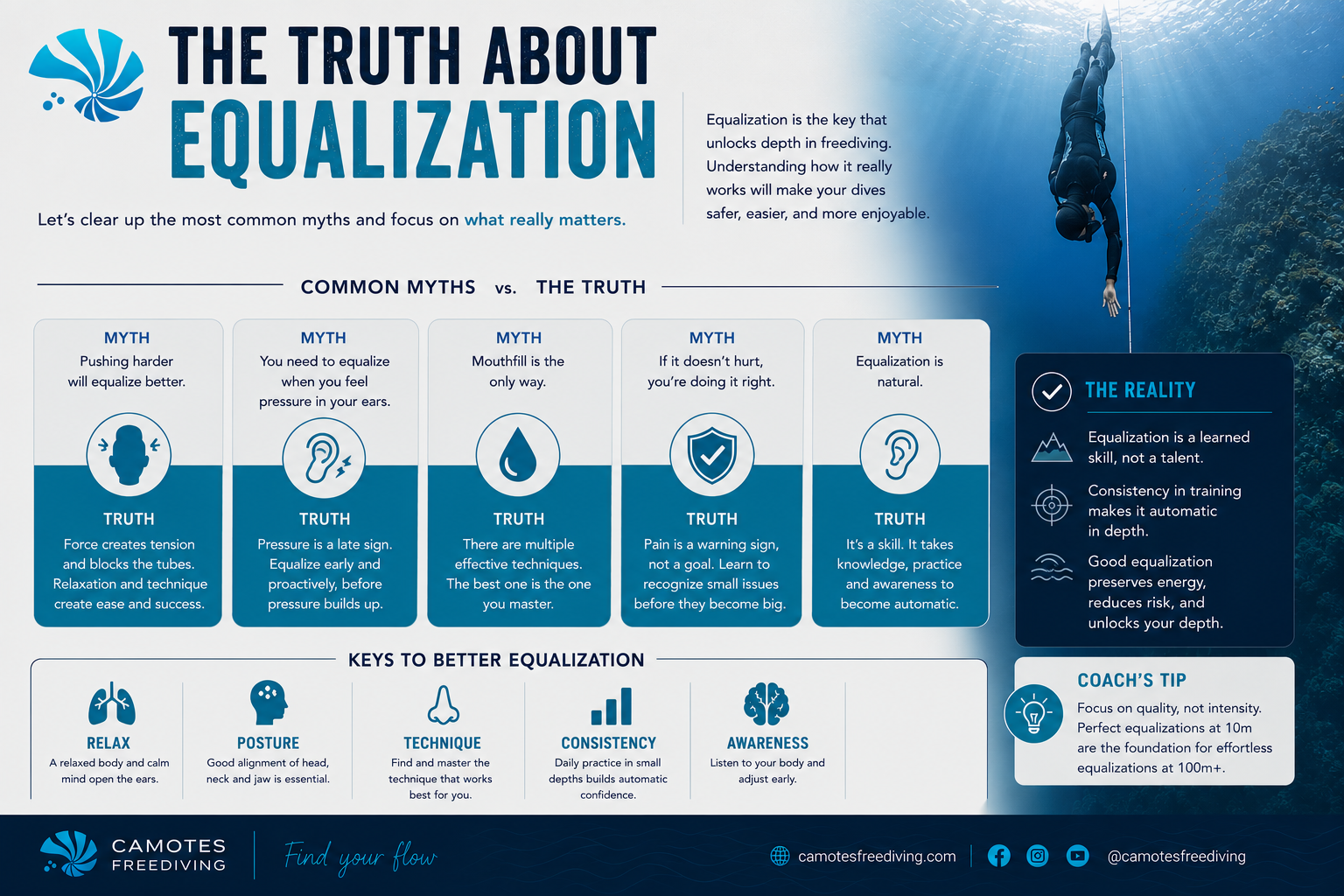

Equalization Is an individual journey
For some people, equalization comes easy, so don’t put any limitations on yourself before even trying. Some people learn faster, some people have more naturally open Eustachian tubes, and some have practiced movements similar to equalization without realizing it. But equalization is fundamentally a motor skill. Just like learning to ride a bicycle, or learning to play the piano. Nobody expects to master the piano after one lesson. Yet many beginners expect perfect equalization after watching a five-minute YouTube video. Unfortunately, that’s not always how it works.
What Actually Happens When You Equalize?
Before we try to improve something, we first need to understand it. As you descend underwater, the surrounding pressure increases rapidly. That pressure pushes inward on your eardrums. If you don’t introduce air into your middle ear, your eardrums bend inward, causing discomfort and eventually pain. Equalization simply restores balance. You’re adding air to the middle ear so the pressure inside matches the pressure outside. Simple in theory. Sometimes more challenging in practice.
The Problem Isn’t Pressure
Many students tell me: “I can equalize on land, but not underwater.” That’s actually very common.
It can come either from using an inadequate equalization technique or simplye because you are overwhelmed by the environment. On land, you have plenty of time, no pressure, no urgency, no movement. Underwater everything changes. You’re descending. You’re thinking about your finning, trying to relax, trying to do the right movements. Suddenly your brain is juggling ten different tasks. Equalization becomes harder—not because your ears changed, but because your attention did.
Why Most Beginners Learn the Wrong Technique
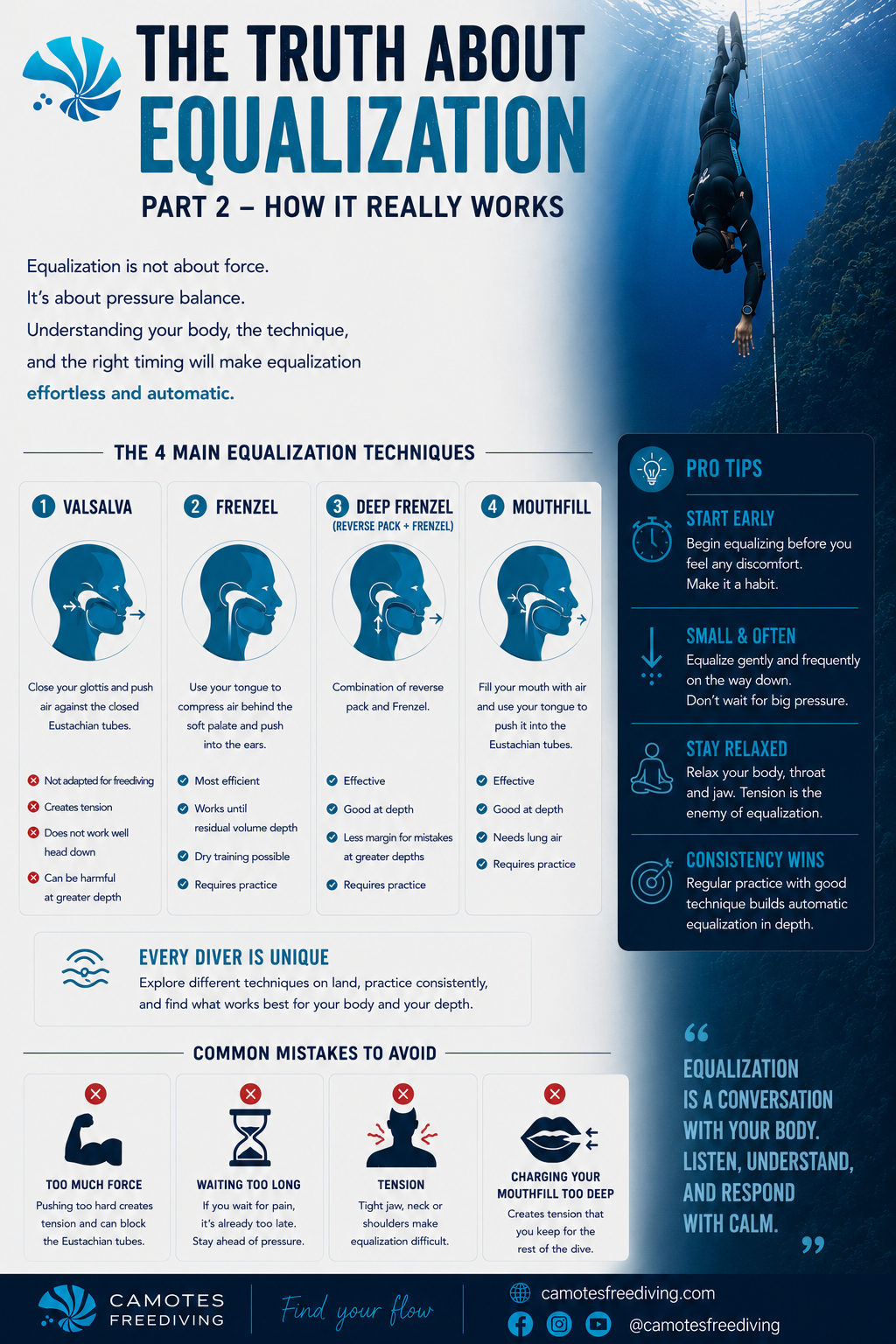
Most people are first introduced to the Valsalva maneuver. You pinch your nose. Blow. Your ears pop. It works.
Unfortunately, you are using a lot of muscles, therefore creating discomfort. In addition, Valsalva rarely works head down. Furthermore, past a certain depth, you could even hurt yourself using Valsava. That’s why, from the start, we favor the Frenzel manoeuver. Because it’s dramatically more efficient and safer.
How Do You Know If You Are Using Frenzel?
Frenzel Isn’t About Blowing Harder
This is probably the most important lesson I teach. The goal isn’t to create more pressure, it’s to create pressure more efficiently. In Frenzel equalization, the tongue acts like a piston. Instead of using your lungs, you’re using a very small volume of air inside your mouth and throat. That means:
- less effort
- greater precision
- much better efficiency
- far less energy expenditure
The difference is enormous.
Why Does My Frenzel Stop Working at Depth?
Coach’s Tip: Equalization should never feel like a battle. The easier it feels, the better you’re usually doing it. Precision always beats force.
Stop Chasing the “Perfect Position”
One of the biggest mistakes I see is people searching endlessly for the perfect tongue position. Should it be T? K? N? Should the tip touch the teeth? The palate? The gums?
The truth is that these positions are simply tools. Different instructors describe them differently because they’re trying to help students feel the same movement. Don’t become obsessed with letters. Become obsessed with understanding what your tongue is actually doing.


Relaxation Comes Before Equalization
Many students think equalization is purely mechanical. It isn’t. The more tension you carry in your:
- neck
- jaw
- throat
- shoulders
- face
…the more difficult equalization becomes. I’ve seen divers spend time trying to improve their Frenzel technique when the real problem was that they were clenching their jaw every time they descended. Sometimes improving equalization starts with learning to relax.
Relaxation Is the Greatest Performance Enhancer in Freediving
Depth Doesn’t Cause Equalization Problems
This surprises many people. Depth doesn’t create poor technique, it simply exposes it. Imagine driving a car with slightly misaligned wheels. At 20 km/h you barely notice. At 120 km/h the problem becomes obvious. Equalization works the same way. Small technical errors become larger and larger as depth increases. That’s why I encourage students to become almost obsessive about perfect equalization in the first ten meters. Deep dives are simply an extension of shallow ones.
Never Wait Until It Hurts
This is another beginner mistake. Some people wait until they feel pressure before equalizing. By then you’re already late. Good freedivers equalize proactively. They stay ahead of the pressure instead of constantly trying to catch up. Think of it like brushing your teeth. You don’t wait until you have cavities. You prevent them. Equalization works exactly the same way.
The Biggest Enemy Is Rushing
When students struggle, they usually do the same thing. They kick harder, descend faster, try again, try harder. Unfortunately, that usually makes things worse. One of my favourite sayings is: Slow is smooth. Smooth is fast. Take your time, pause if necessary. Reset, relax, then continue. And there is always another dive. The ocean isn’t going anywhere.

Equalization Is Mostly About Awareness
Many people ask me: “Can you teach me your equalization technique?”
I usually smile because there isn’t really my technique. The fundamentals are the same for everyone. What changes is awareness.
Can you feel your soft palate? Your tongue? Your larynx? Can you isolate these movements independently?
That’s where progress happens. The better you understand your own anatomy, the easier equalization becomes.
Dry Practice Is More Important Than Most People Think
Many divers only practice equalization when they’re underwater. Imagine trying to learn piano by only touching the keys once a week. It wouldn’t work. The same applies here.
A few minutes of focused dry practice every day often produces more progress than several dives without understanding what you’re doing.
One Mistake I See Often: Students spend hours searching for a ‘secret technique.’ In reality, the secret is usually hundreds of relaxed, high-quality repetitions.
Mouthfill Isn’t Magic
Eventually, divers progressing beyond approximately 40 to 50 meters will hear about mouthfill. Some imagine it’s a magical technique that suddenly unlocks great depth. It isn’t. Mouthfill is simply another solution to a problem created by increasing pressure. Without strong Frenzel fundamentals, mouthfill usually becomes another source of frustration.
My advice is always the same: Master the basics first. Everything else becomes easier afterward.
Your Brain Learns Through Repetition
Equalization isn’t something you consciously control forever. Eventually it becomes automatic. Just like changing gears while driving. Or typing on a keyboard. That only happens through thousands of correct repetitions. Not rushed repetitions. Correct repetitions. Every good equalization teaches your nervous system. Every poor repetition teaches it something too. That’s why practicing correctly matters so much.
Why I Love Teaching Equalization
Equalization is probably the most rewarding subject I teach. Not because it’s easy. Because it’s difficult. I’ve watched students arrive convinced they simply “couldn’t equalize.” Some had already visited multiple instructors. Others believed they would never dive deeper than five meters. Then something clicks. A tiny movement. A new sensation. Suddenly everything changes. Sometimes the biggest breakthroughs happen in just a few minutes—not because they learned something completely new, but because they finally understood something their body had been trying to tell them all along. Those moments remind me why I still love teaching.
Common Equalization Mistakes
Over the years I’ve seen the same mistakes repeated again and again:
- Waiting too long before equalizing.
- Descending too quickly.
- Using Valsalva too deep.
- Clenching the jaw.
- Lifting the chin.
- Looking downward instead of maintaining a neutral head position.
- Trying to force pressure.
- Becoming frustrated after one unsuccessful dive.
- Practicing inconsistently.
- Obsessing over depth instead of technique.
The encouraging part? Every one of these mistakes can be corrected.
Why Can’t I Equalize? 15 Ways to Fix It
My Advice to Every Freediver
If equalization feels difficult, don’t assume you’re untalented. Don’t compare yourself to someone who has been practicing for years. Don’t rush. And definitely don’t force it. Equalization rewards patience more than determination. Approach it with curiosity instead of frustration. Become fascinated by how your own body works. That’s when real progress begins.
Frequently Asked Questions
Why can I equalize on land but not underwater?
Because underwater you’re managing many more tasks simultaneously, and pressure increases continuously as you descend. Relaxation, body position, and timing all become much more important.
Should equalization ever hurt?
No.
Discomfort means you need to stop, ascend slightly if necessary, and regain control. Pain is never something you should push through.
How long does it take to learn Frenzel?
For some students, a few minutes.
For others, several weeks.
The timeline matters far less than practicing correctly.
Can everyone learn to equalize?
Most people can develop excellent equalization with proper coaching and consistent practice. Occasionally, anatomical or medical issues require assessment by an ENT specialist, but these are much less common than most people assume.
When should I learn mouthfill?
Only after your Frenzel technique is reliable and effortless. Mouthfill builds upon strong fundamentals—it doesn’t replace them.
Final Thoughts
Equalization isn’t the obstacle standing between you and deeper dives. It’s the pathway. The better you understand it, the more relaxed your dives become. The more relaxed your dives become, the more enjoyable freediving becomes. Take your time. Master the fundamentals. Celebrate small improvements. And remember that every world-class freediver once struggled with exactly the same challenges. The goal isn’t to equalize perfectly overnight. The goal is to become just a little more efficient every time you enter the water. Because in freediving, the biggest breakthroughs rarely happen through force. They happen through understanding.
Further Reading:
How to Equalize Your Ears for Freediving
Why Can’t I Equalize? 15 Ways to Fix It
How to Learn the Frenzel Technique


