

Why Does One Ear Equalize but Not the Other?
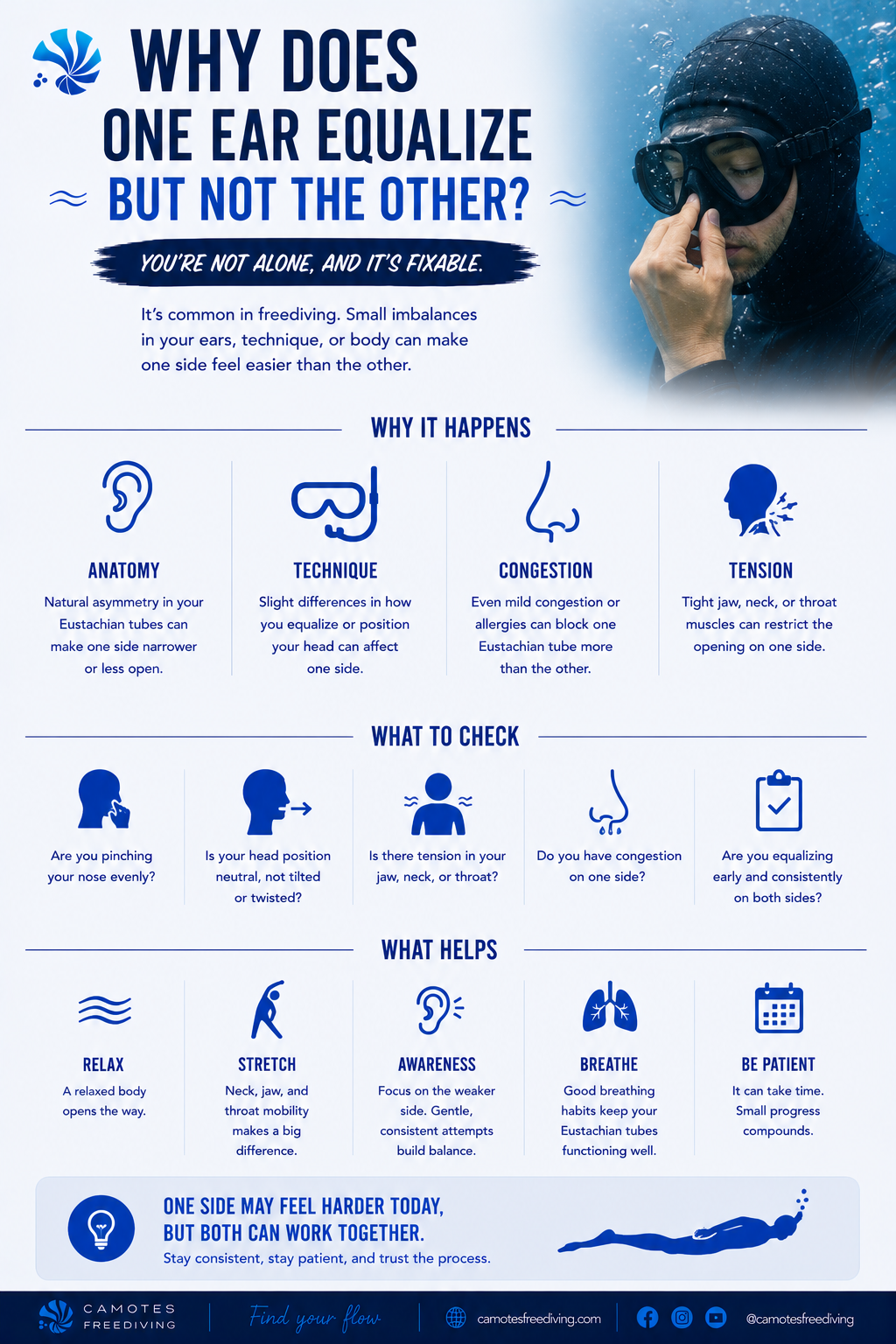
You’re descending. Your left ear equalizes perfectly. Your right ear doesn’t. You stop. Try again. Still nothing. Sound familiar? If so, you’re far from alone.
In fact, this is probably one of the common equalization issues I see during beginner and intermediate freediving courses. The good news is that it usually doesn’t mean anything is seriously wrong. More often than not, there’s a logical explanation—and a solution. Let’s look at the most common reasons why one ear behaves differently from the other.
First of All…
Your Body Is Not Perfectly Symmetrical
One of the biggest misconceptions is that both ears should behave exactly the same. They don’t. Almost nobody has a perfectly symmetrical body. One nostril is usually slightly more open than the other. One shoulder often has more mobility. One ankle is more flexible. Your ears are no different. Small anatomical differences are completely normal.
One Eustachian Tube May Be Slightly Narrower
The Eustachian tubes connect your middle ears to the back of your throat. They allow air to enter the middle ear during equalization. Sometimes one tube simply opens more easily than the other. This doesn’t necessarily mean it’s abnormal. It just means one side requires slightly better timing or technique.
Congestion Is Rarely Symmetrical
Even a mild cold or seasonal allergies can affect one side more than the other. You might not even feel sick. But slight swelling inside one Eustachian tube can dramatically change how easily it opens. Many divers notice this during allergy season. Or after a poor night’s sleep. Or following air travel.
Your Head Position Might Be the Problem
This is something I correct surprisingly often. Tiny differences in head position can affect equalization. Some divers naturally rotate their head slightly during the descent. Others tilt one shoulder. These small asymmetries change the alignment of the Eustachian tubes. Sometimes correcting posture immediately improves the “difficult” ear.
You’re not Equalizing often enough
Pressure doesn’t build equally on both ears. If one side opens slightly later than the other, waiting until you feel pressure often makes the problem much worse. Equalize more often. Way more often than you think necessary. Gentle. Frequent. Continuous.
Coach’s Tip: If one ear is consistently slower, start your equalization even earlier and more frequently than usual and stay patient. Forcing almost never helps.
Stress Makes Everything Worse
One interesting thing I’ve observed over the years is that students often become obsessed with “the bad ear.” Every dive becomes a test. “Will it work today?” That anticipation creates tension. Tension affects equalization. Equalization becomes more difficult. The cycle continues. Sometimes the biggest improvement comes from changing attention rather than changing technique.


Never Force One Ear
This is one of the most important points in this article. If one ear isn’t equalizing… Don’t force it. Pain is way past your signal to stop. When you feel any discomfort, Stop, Ascend slightly. Relax. Reset. Try again.
Dry Practice Can Reveal a Lot
One reason I encourage students to practice equalization on land is that asymmetries become much easier to observe. Without depth. Without buoyancy. Without pressure. You can simply explore: Can you feel both ears opening? Does one side consistently respond later? Can you reproduce the movement gently? Understanding the movement on land often makes underwater progress much faster.
Sometimes the Problem Isn’t the Ear
This surprises many students. They’re convinced something is wrong with the ear itself. Often the issue is somewhere else entirely. Jaw tension, neck tension, poor posture, tongue movement, timing, relaxation, everything is connected. That’s why treating equalization as a full-body skill often produces the biggest breakthroughs
One Mistake I See Often: Divers twist or tilt their head dramatically to compensate instead of solving the underlying technique issue.
Could It Be Medical?
Occasionally. If one ear has persistent pain, repeated infections, hearing changes, previous surgery, or consistently refuses to equalize despite good technique… It’s worth consulting an ENT physician who understands diving. Most equalization problems are technical. But medical issues should never be ignored.
What I Usually See as an Instructor
After hundreds of courses, here’s what I’ve noticed. Very few students have “bad ears.” Most have: Poor timing, too much tension, too much speed, or simply insufficient understanding of the movement. That’s encouraging. Because those are all things we can improve.
Why Can I Equalize on Land but Not Upside Down?
My Advice
If one ear consistently feels more difficult… Don’t panic. Don’t assume you’ve reached your limit. Instead, become curious. Ask: What changes if I descend more slowly? What happens if I equalize even more often? What if I relax my jaw? What if I stop thinking about the difficult ear altogether? Curiosity is often your greatest teacher.
Five Things to Try Tomorrow
Before your next dive, try these five simple ideas.
- Equalize earlier than usual.
Don’t wait for pressure.
- Slow your descent.
Give both ears time to respond.
- Relax your jaw and neck.
Unnecessary tension often affects only one side.
- Practice Frenzel on land.
Develop symmetry before adding pressure.
- If one ear hurts…
Stop. Pain is never part of good equalization.
Frequently Asked Questions
Is it normal for one ear to equalize more easily?
Yes. Minor anatomical differences are extremely common and usually nothing to worry about.
Can allergies affect only one ear?
Absolutely. Mild congestion often affects one Eustachian tube more than the other.
Should I force a difficult ear?
Never. Forcing equalization increases the risk of ear injury.
Can posture affect equalization?
Yes. Small changes in head and neck position can significantly influence how easily your ears equalize.
When should I see an ENT?
If the problem is persistent, painful, associated with hearing loss, or doesn’t improve despite good technique and coaching.
Final Thoughts
One ear equalizing more easily than the other is one of those problems that feels much bigger than it usually is. I’ve watched countless students worry that something was fundamentally wrong. Then… One adjustment, one coaching cue, one moment of understanding… And suddenly both ears worked beautifully. Equalization is rarely about finding more force. It’s about finding more precision, more awareness, more patience. Trust the process, stay curious, and remember: your ears aren’t trying to stop you from diving, they’re simply asking you to understand them a little better.
The Ultimate Guide to Freediving in the Philippines
Further Reading:
How to Equalize Your Ears for Freediving
How to Learn the Frenzel Technique
How Do You Know If You Are Using Frenzel?


