The Ultimate Guide to Freediving in the Philippines
If you’ve been thinking about learning to freedive, improving your depth, or even becoming an instructor, there’s a good chance you’ve come across the Philippines.
And that’s no coincidence.
After coaching hundreds of students from complete beginners to instructor candidates, organizing international competitions, and spending years training in these waters myself, I genuinely believe the Philippines offers some of the best freediving opportunities anywhere in the world.
Of course, I’m biased—I chose to build my life here. But I also travel regularly for competitions and training, and every time I come back, I’m reminded why.
Warm water. Incredible marine life. Friendly people. Affordable travel. And most importantly, year-round opportunities to dive.
In this guide, I’d like to share what I’ve learned over the years—not as a travel blogger, but as someone who spends almost every day in the water.
Whether you’re looking for your very first freediving course or dreaming of diving beyond 100 meters one day, this guide will help you understand why so many freedivers eventually find themselves in the Philippines.
Why the Philippines Has Become a World-Class Freediving Destination
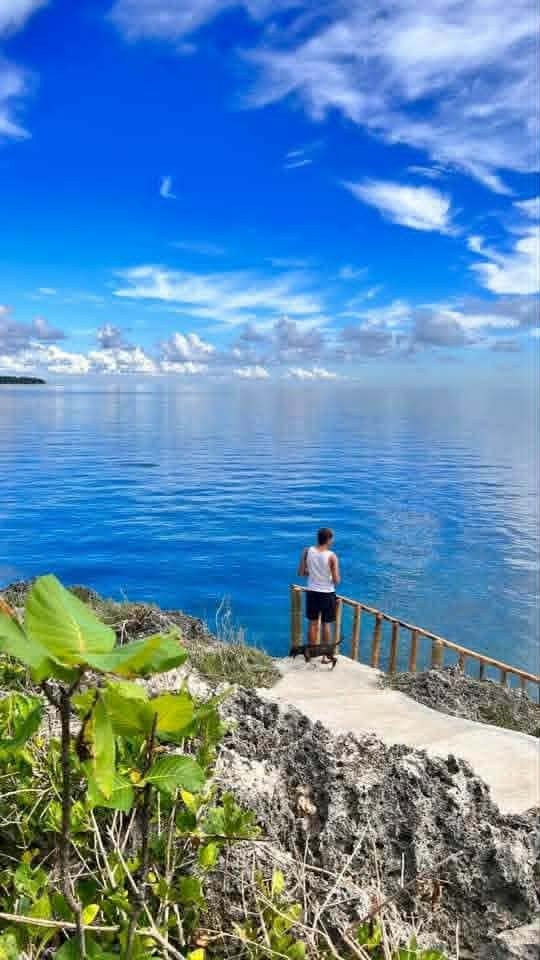
The Philippines is made up of more than 7,000 islands, surrounded by warm tropical waters and an astonishing variety of dive sites.
Unlike many destinations that only offer a short diving season, large parts of the Philippines can be dived almost year-round.
Water temperatures generally range between 27°C and 30°C, meaning that many divers are comfortable wearing only a thin wetsuit—or sometimes just a swimsuit during pool training.
Visibility often reaches 20 to 40 meters, and on exceptional days it can be even better.
But conditions alone don’t explain why freediving has grown so much here.
The country has developed an incredibly welcoming freediving community. Whether you’re joining your first Wave 1 course or preparing for an international competition, you’ll quickly notice that experienced divers are approachable, supportive, and genuinely happy to help newcomers.
That’s something I love about this sport.
Freediving isn’t about beating the person next to you.
It’s about becoming a better version of yourself.

Why More and More Freedivers Travel to the Philippines
Over the last decade I’ve seen students arrive from every corner of the world. Some come for a week, others never really leave. There are several reasons why:
Perfect Water Temperature
Cold water creates unnecessary tension. When you’re learning to relax, equalize efficiently, and enjoy longer dives, warm water makes everything easier. It allows you to focus on technique instead of fighting the environment.
Affordable Training
Compared to many destinations in Europe or North America, the Philippines offers outstanding value. Accommodation, food, transportation and training are often significantly more affordable while maintaining a very high standard.
That allows many students to stay longer, which usually leads to much better progress. One week is enough to discover freediving. One month can completely change your level.
Incredible Marine Life
One of the greatest joys of freediving is becoming part of the underwater world instead of simply observing it through bubbles. Depending on where you dive, you may encounter:
- turtles
- sardine schools
- reef sharks
- colorful coral reefs
- whale sharks (seasonally in certain areas)
- dolphins
- countless tropical fish
Every dive becomes an adventure.
Where Can You Freedive in the Philippines?

From My Experience: Don’t choose your destination based only on beautiful underwater photos. Choose the place where you’ll receive the best coaching. A great instructor will improve your freediving much more than perfect visibility ever will.
This is probably the question I get asked most often. The truth is that there isn’t one single answer. Different locations suit different goals.
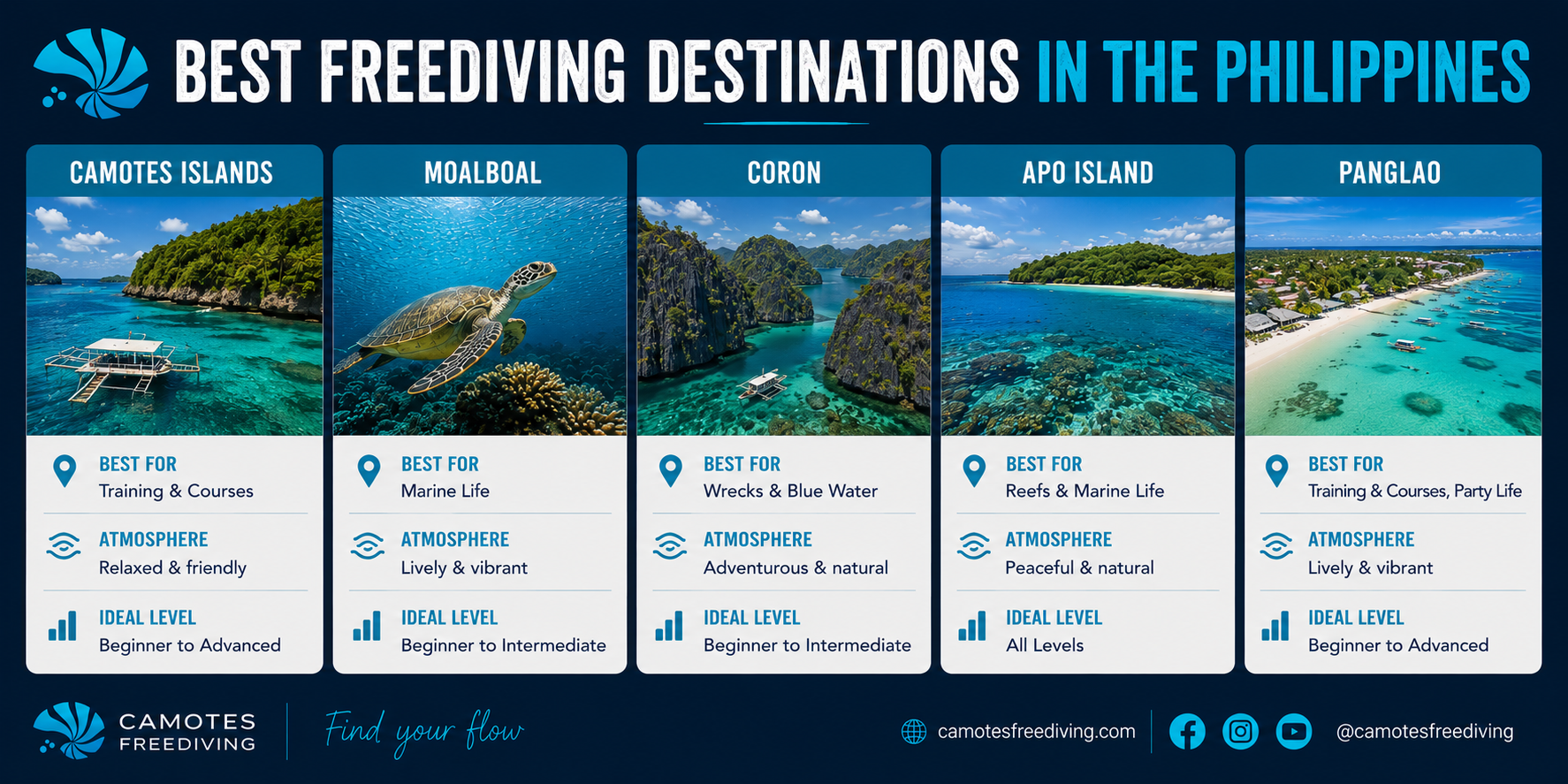
Panglao
Probably the best-known freediving destination in the country. Panglao has numerous schools, easy access from Cebu and Manila, and a very active freediving community. If you enjoy social environments and many training partners, it’s a great option. The downside is that popularity also means busier dive sites and schools.
Moalboal
Famous for its sardine run and scuba diving. Freediving is growing rapidly here as well. The scenery is spectacular, although deep training conditions are generally different from purpose-built training locations.
Batangas
Very popular with divers living in Manila because of its accessibility. Ideal for weekend trips.
Coron
One of the most beautiful places in the Philippines. Known primarily for wreck diving and incredible scenery rather than deep freediving training. Definitely worth visiting if you’re combining freediving with exploration.
Why I Chose Camotes Islands
When I first arrived in Camotes, I wasn’t planning on staying. Like many people, I thought I’d spend a few days here before moving on. Instead, I found exactly what I had been searching for.
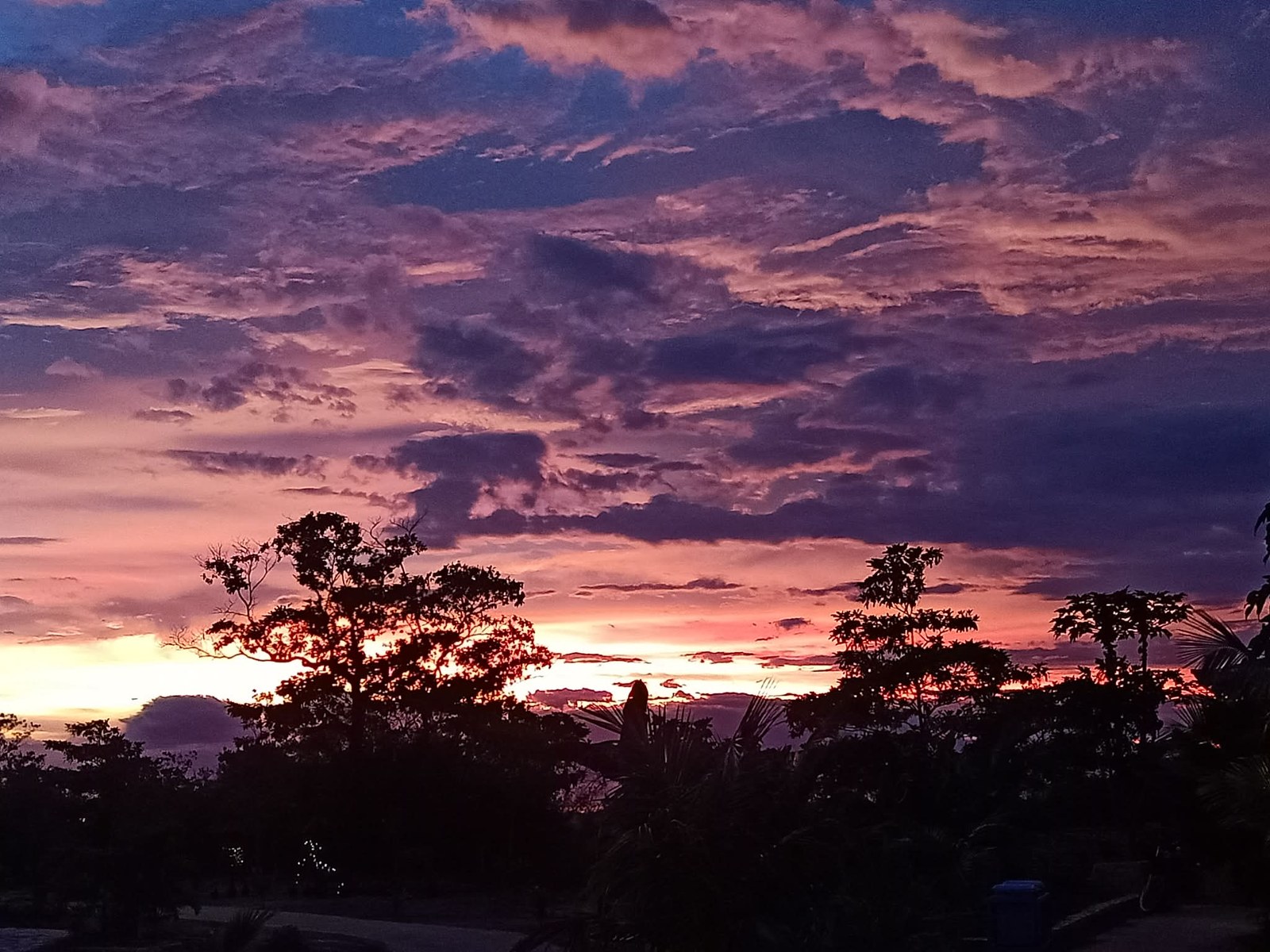
Quiet. Natural. Safe. Beautiful. And ideal for serious freediving (no current and good conditions all year round). That’s ultimately why I decided to build my school here.
What Makes Camotes Different?
One of the biggest challenges when learning freediving is consistency. You improve through repetition. You improve by diving regularly. You improve when conditions don’t constantly interrupt your training. Camotes offers remarkably consistent conditions for much of the year.
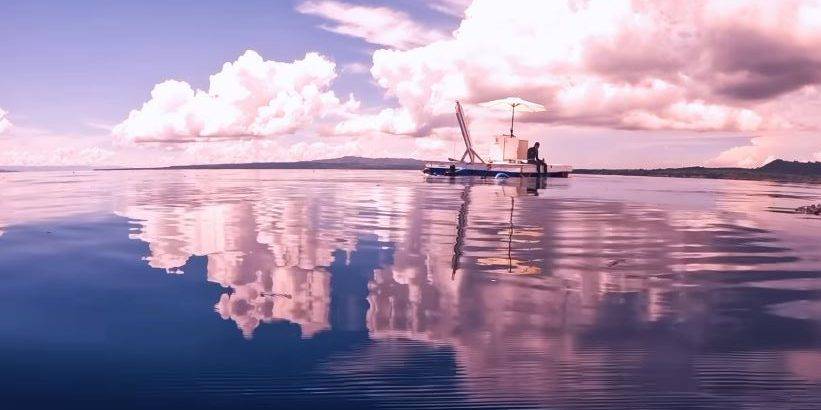
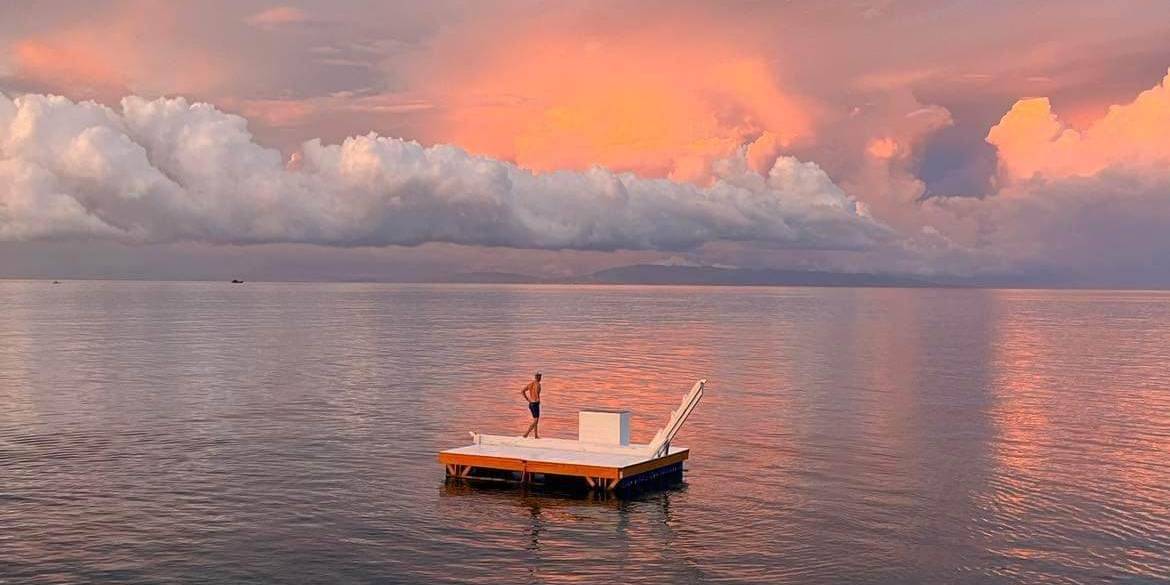
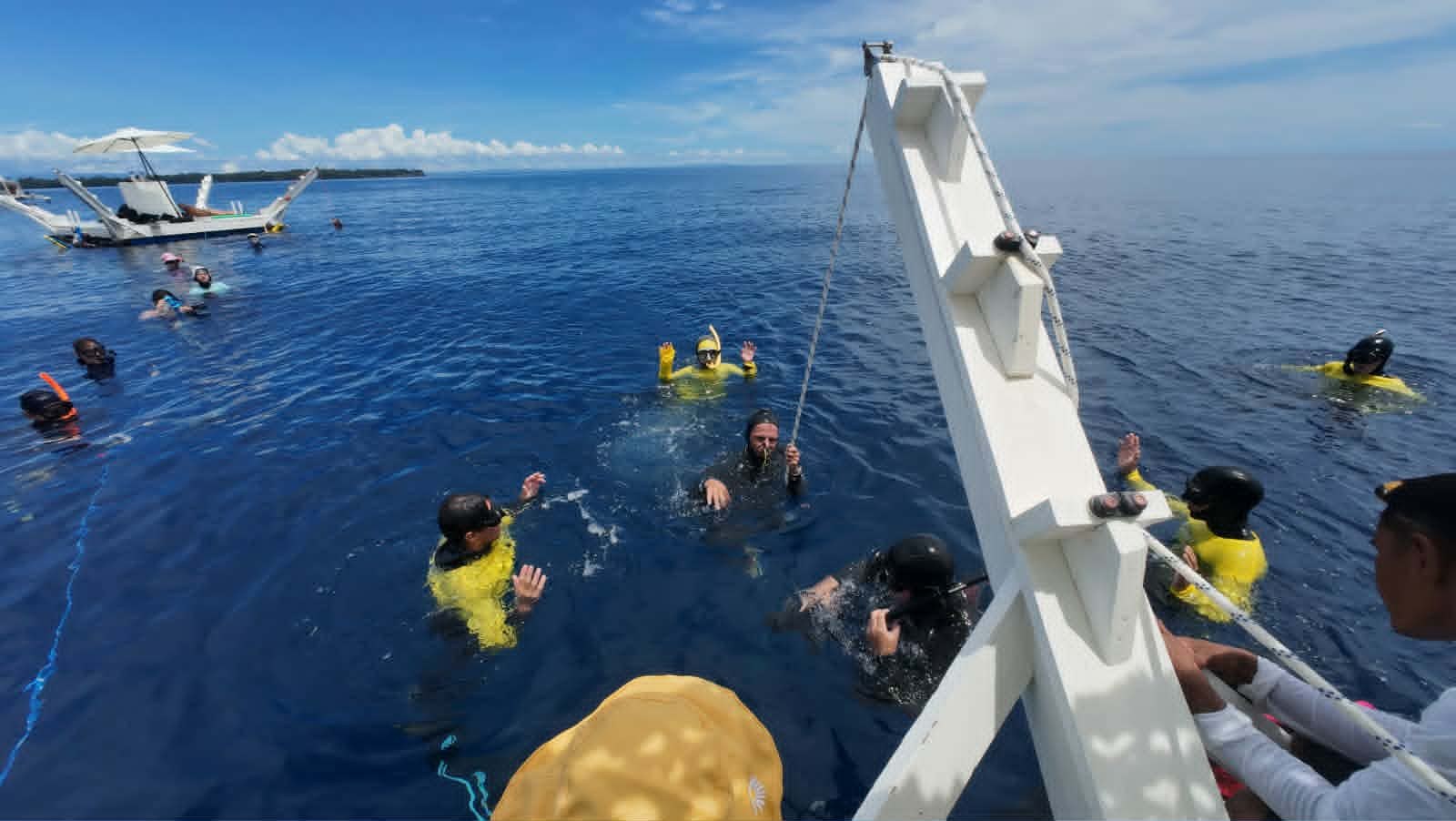
Our training platform is only a few minutes by boat. Current is generally minimal. The water is warm. Visibility is excellent.
That allows students to spend their energy learning instead of adapting to difficult conditions every day.
Why Camotes Island Is One of the Best Places in the World to Learn Freediving
Learning From Beginners to Elite Athletes
One misconception I often hear is that deep training centers are only for advanced freedivers.
Nothing could be further from the truth. In reality, beginners benefit enormously from learning in an environment specifically designed for freediving. Our students include:
- complete beginners
- recreational divers
- underwater photographers
- scuba divers crossing over
- instructors
- national record holders
- world championship athletes
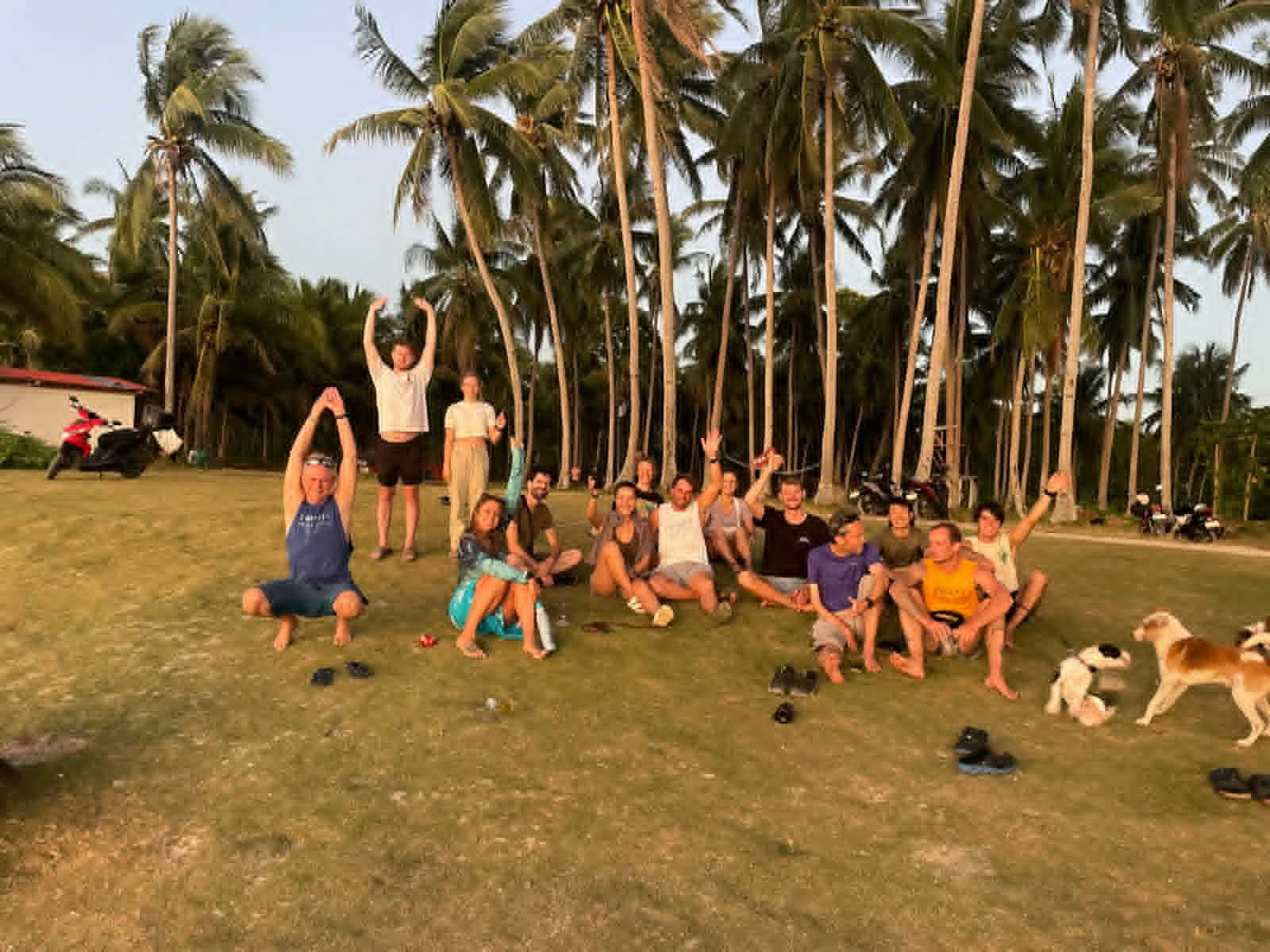
Everyone trains together. Everyone learns from each other. That’s one of my favorite aspects of the freediving community.
How to Choose the Right Freediving School
This is probably the most important advice I can give. Don’t choose your school based solely on price. A cheaper course quickly becomes expensive if you leave with poor technique or unsafe habits. Instead, ask yourself a few questions.
How to Choose the Best Freediving School
Are the instructors experienced?
Not only in teaching. Can they explain concepts in different ways? Can they adapt to different learning styles? Have they continued developing their own skills? Great athletes don’t automatically become great coaches. Likewise, great coaches don’t need to be world champions. What matters is their ability to help you improve safely.
Is Safety Truly a Priority?
Every school talks about safety. Look deeper.
How many students are in the water?
What rescue procedures exist?
How much supervision is provided?
What emergency equipment is available?
These questions matter. In freediving, safety is never something you compromise.
Does the School Focus on Long-Term Progress?
Some schools are very good at helping students pass certification requirements. Fewer schools focus on building divers who continue progressing for years afterward. Personally, I care far more about how you dive six months after your course than how you perform on the final day.
What I Tell My Students: If you have enough time, stay a few extra days after your course. Almost everyone wishes they had. Those additional dives often become the ones where everything finally clicks.
What Happens During Your First Freediving Course?
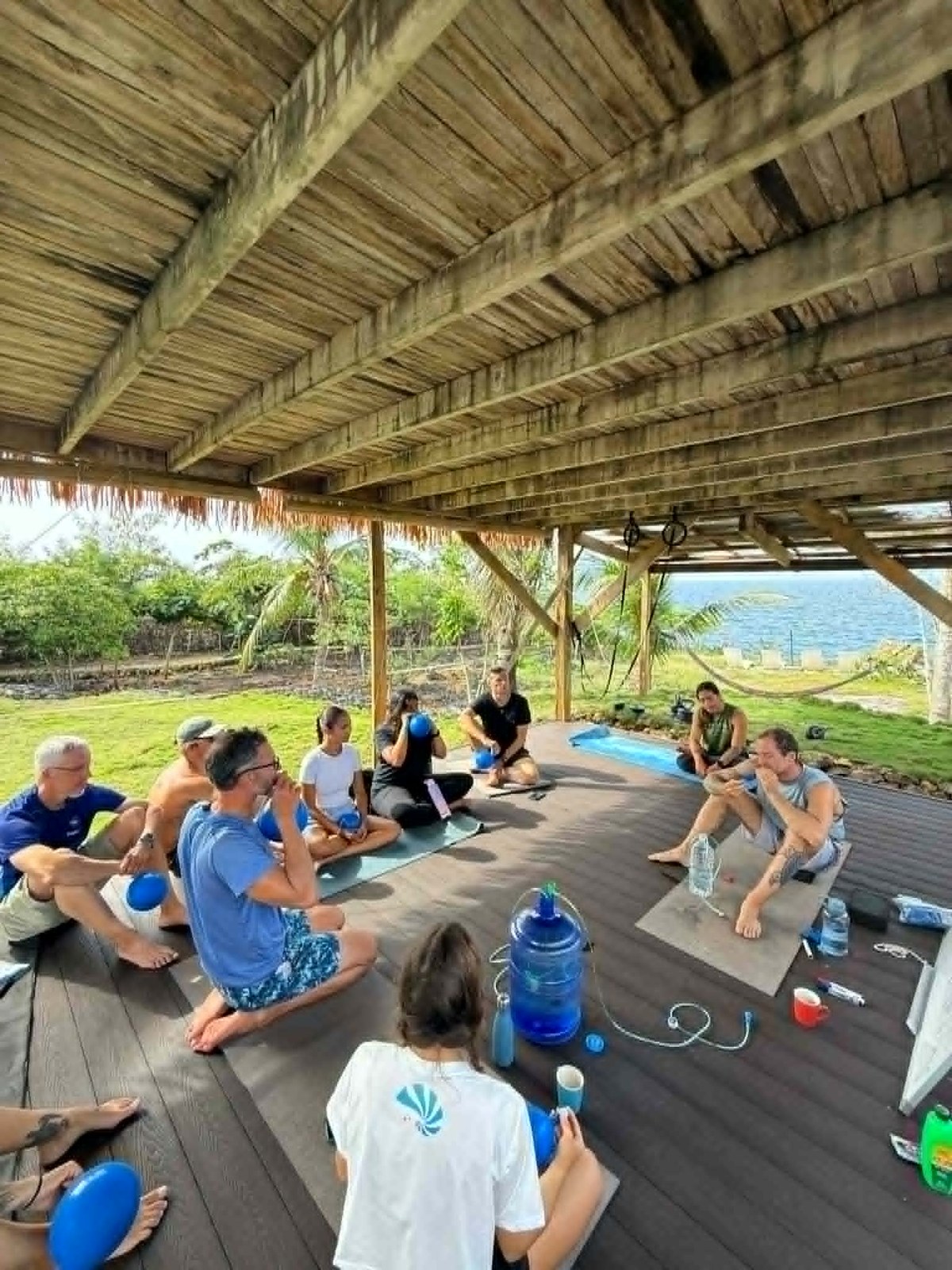
Many beginners imagine holding their breath for several minutes on day one. That’s rarely the goal. Your first course is really about learning a completely new relationship with your body.
You’ll discover:
- breathing techniques
- relaxation
- equalization
- duck dives
- finning technique
- safety procedures
- rescue skills
- buddy awareness
Most students are surprised by one thing. Freediving isn’t about fighting your urge to breathe. It’s about learning to relax so deeply that your body naturally consumes less oxygen. That’s a completely different mindset.
A Day in a Beginner Freediving Course
The Biggest Mistake Beginners Make
Trying too hard. It’s incredibly common. People believe progress comes from effort. In freediving, progress usually comes from removing unnecessary effort.
Relax your shoulders. Relax your face. Relax your thoughts. Slow down.
Almost every improvement starts there. I’ve seen students gain ten or twenty meters not because they became stronger, but because they finally stopped trying to force the dive.
The Biggest Mistake Beginners Make
Trying too hard. It’s incredibly common. People believe progress comes from effort. In freediving, progress usually comes from removing unnecessary effort.
Relax your shoulders. Relax your face. Relax your thoughts. Slow down.
Almost every improvement starts there. I’ve seen students gain ten or twenty meters not because they became stronger, but because they finally stopped trying to force the dive.
Is Freediving Dangerous?
This question deserves an honest answer.
Freediving can absolutely be dangerous. So can climbing, surfing, mountaineering. or driving a car. The key difference lies in education. Proper training dramatically reduces risk.
One of the reasons certification courses place so much emphasis on safety is because accidents almost always happen when basic safety principles are ignored.
Never dive alone. Always dive with trained supervision. Respect your limits. Progress gradually.
These aren’t suggestions. They’re non-negotiable.
How Long Does It Take to Become Good?
Another common question. The answer depends entirely on what “good” means. For some people, becoming comfortable diving to 20 meters is already a dream achieved. Others want to become instructors. Some dream about competitions.
The beautiful thing about freediving is that there is always another level to explore. After more than a decade in the sport, I still feel like I’m learning. That’s one of the reasons I continue loving it.
My Philosophy as a Coach
People often ask me what separates successful students from those who plateau. It’s rarely talent. It’s rarely lung capacity. and it’s almost never bravery.
The students who improve the most share three qualities: They stay curious. They stay patient. And they stay consistent.
Depth is never the objective.Depth is simply the consequence of mastering hundreds of small skills. Every relaxed breath. Every efficient kick. Every cleaner equalization. Every better decision. Meters are simply the result.
Why I Still Love Teaching Beginners
Some people assume coaching elite athletes is more rewarding.
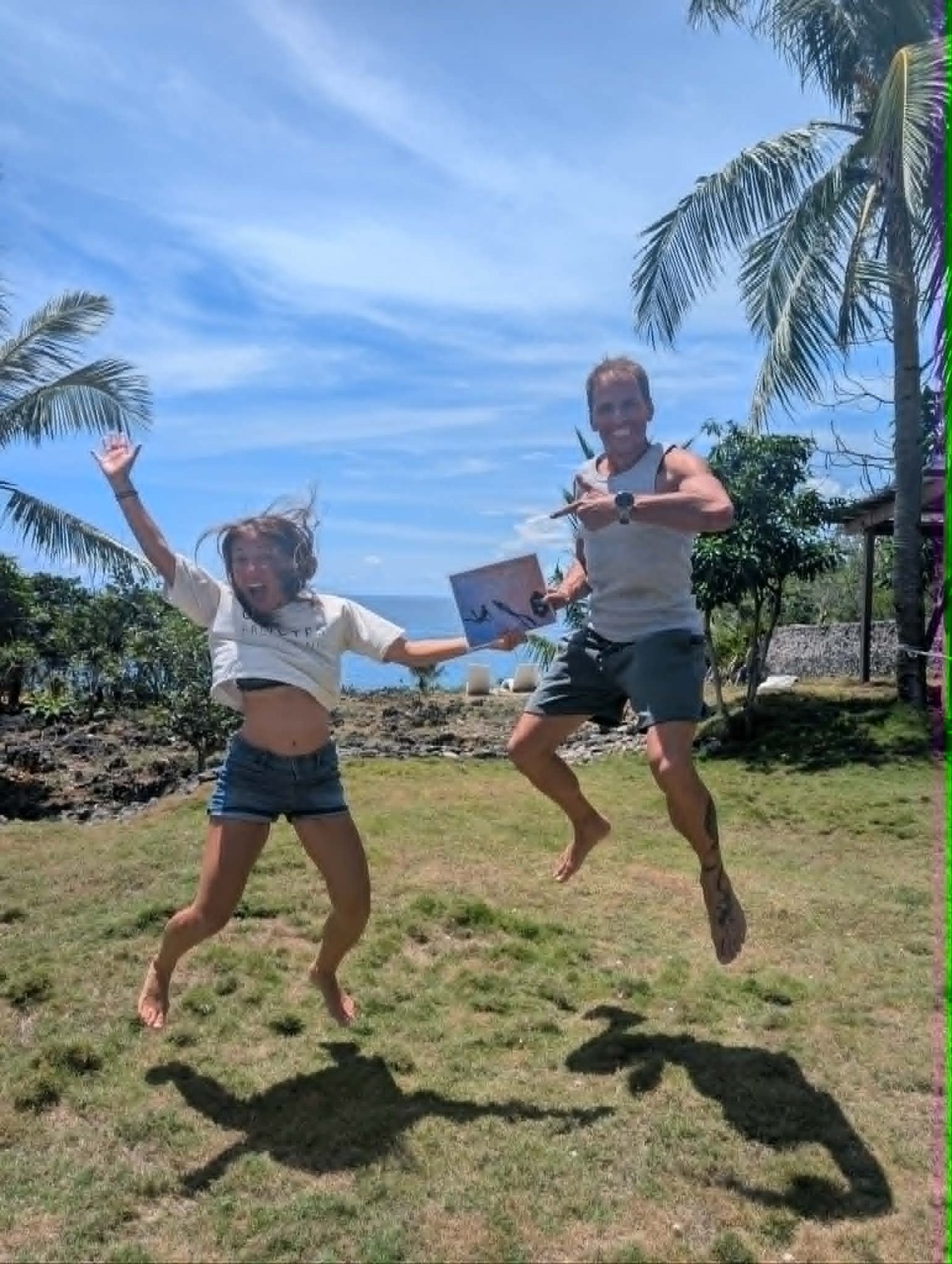
Honestly? Watching someone complete their very first 10-meter dive with a huge smile can be just as satisfying as watching an experienced athlete set a national record.
Because the emotion is the same. They’ve just discovered they were capable of more than they believed. That’s what keeps me passionate after all these years.
Is the Philippines Right for You?
If you’re looking for luxury resorts and nightlife every evening, perhaps another destination will suit you better.
But if you’re looking for warm water, incredible diving, passionate instructors, beautiful islands and an environment where you can truly immerse yourself in freediving, it’s hard to beat the Philippines.
Whether you stay for one week or one month, you’ll almost certainly leave with more than just better breath-hold skills. You’ll leave with a different perspective on relaxation, confidence and what your body is capable of. And for many people—including me—that journey ends up changing much more than just the way they dive.
Frequently Asked Questions
Can I learn freediving if I can’t swim very well?
You should be comfortable in the water, but you don’t need to be an elite swimmer. A quality beginner course is designed to teach the techniques step by step while placing safety first.
Am I too old to start freediving?
Absolutely not. I’ve taught students from teenagers to people in their seventies. Progress depends much more on patience, consistency, and mindset than on age.
Do I need to be very fit?
No. A reasonable level of general health is helpful, but freediving rewards relaxation and efficiency far more than brute strength.
How many days should I stay?
If you’re travelling internationally, I always recommend staying longer than the minimum course duration. You’ll adapt to the environment, gain confidence, and have time to consolidate your new skills instead of rushing through the experience.
What is the best time to visit?
Different regions of the Philippines have different seasons, which is one of the country’s great advantages. Research the specific area you’re planning to visit, and if your goal is serious training, ask the local school about the best months for conditions.
The Best Time to Learn Freediving in Camotes
Final Thoughts
Freediving has taken me to places I never imagined when I started. It has allowed me to meet incredible people, explore extraordinary underwater landscapes, and discover that the greatest limits are often the ones we place on ourselves.
The Philippines has been at the heart of that journey.
If you’re thinking about learning to freedive, improving your skills, or simply experiencing one of the most beautiful underwater environments in the world, I genuinely believe you’ll find something special here.
Wherever you choose to train, choose a school that values safety, quality coaching, and long-term development over quick results. Build strong foundations, enjoy the process, and remember that every great freediver started with a single breath.
I hope to see you underwater one day.
Further Reading:
How to Choose the Best Freediving School in the Philippines
Why Camotes Island Is One of the Best Places in the World to Learn Freediving
Camotes vs Panglao for Freediving