

How Do You Know If You’re Really Doing Frenzel in Freediving?

How Do You Know If You’re Really Doing Frenzel?
One of the questions I hear almost every week is: “I think I’m doing Frenzel… but how can I be sure?” It’s a fantastic question. Because here’s the reality. Many divers believe they’ve learned Frenzel… When in fact they’re still using a modified version of Valsalva. Sometimes it works down to 15 or 20 or 30 meters. Then suddenly everything falls apart. The reason is simple. They never actually changed fully the way they generate pressure. They simply became better at Valsalva and mixed it with some Frenzel. Understanding the difference early can save months of frustration.
First…
Forget About The Sound
One Mistake I See Often: Students judge Frenzel by the sound instead of the mechanics.
Many people judge Frenzel by the little “pop” they hear. That isn’t reliable. Some people hear a loud click. Others hear almost nothing. Some ears equalize silently. The sound tells you very little. Instead… Pay attention to where the pressure comes from.
Sign #1
Your Chest Doesn’t Move
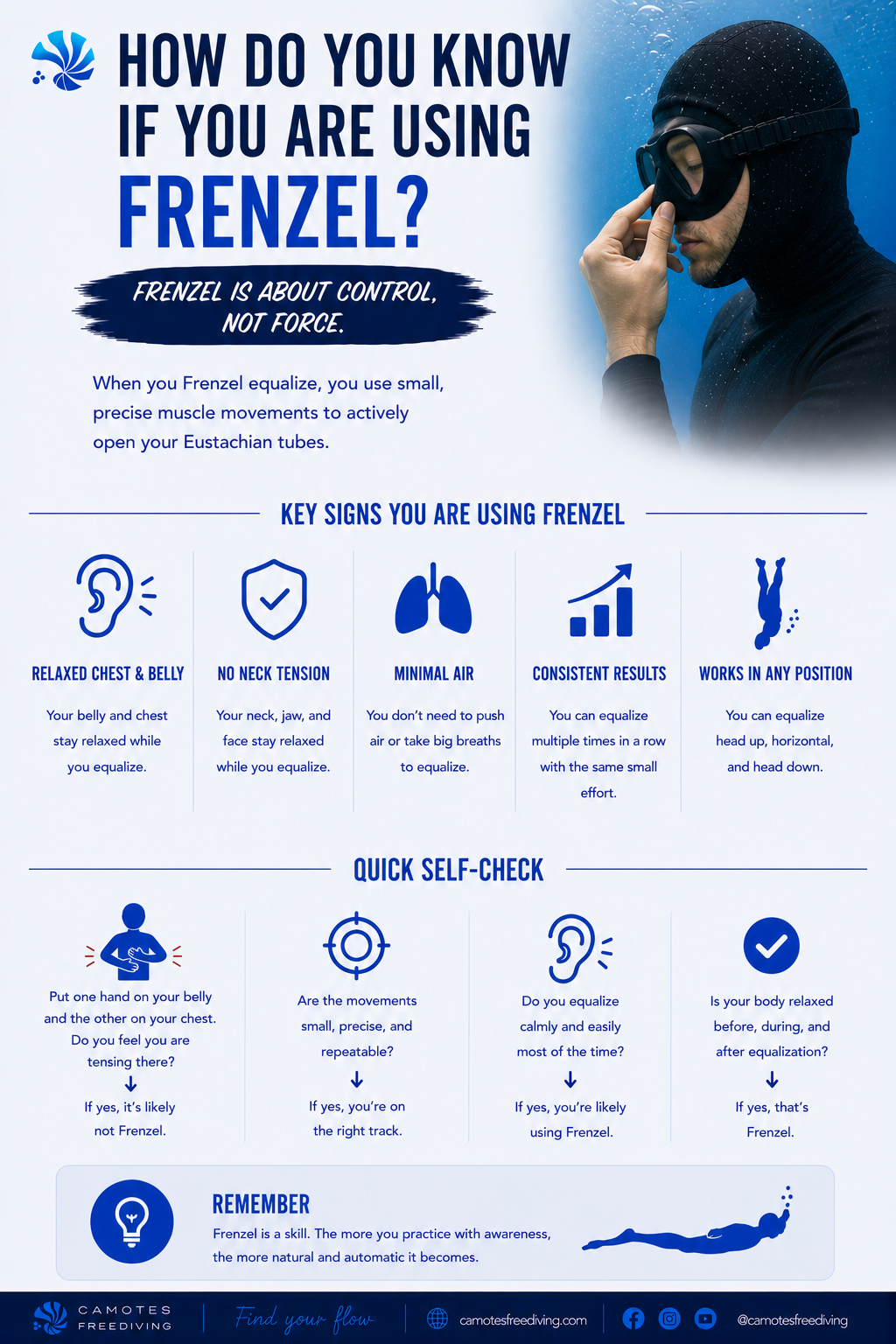
This is probably the easiest sign. During true Frenzel, your chest should remain almost completely still. You’re not blowing from your lungs. You’re compressing a tiny pocket of air inside your mouth. If your chest visibly expands or contracts…You’re probably still relying on Valsalva.
Sign #2
Your Abdominal Muscles Stay Relaxed
Try this. Place one hand on your stomach. Perform an equalization. If your abdominal muscles tense even slightly… You’re almost certainly generating pressure from below. Good Frenzel requires surprisingly little effort.
Sign #3
The Pressure Feels Local
With Valsalva, you often feel pressure building throughout your chest and throat. With Frenzel… Everything feels much more local. The movement happens around the mouth, tongue and upper throat. That’s one of its biggest advantages.

Sign #4
You Can Equalize With Very Little Air
This is one of the biggest clues. Imagine taking only a tiny sip of air into your mouth. Can you still equalize? If yes… That’s a very good sign. Frenzel doesn’t need a huge reservoir of air.
Sign #5
You Don’t Feel Like You’re Blowing
Ask yourself a simple question. Does it feel like you’re trying to blow through your nose? If the answer is yes… You’re probably still using Valsalva. Frenzel feels more like compressing than blowing. It’s subtle. But the difference is enormous.
Sign #6
The Movement Is Small
One thing surprises almost every student. Good Frenzel is tiny. There are no dramatic movements. No huge effort. No obvious strain. The better someone becomes… The smaller the movement usually gets.
Sign #7
You Can Repeat It Easily
Good Frenzel isn’t something you can do once. It becomes repeatable. Smooth. Consistent. Almost boring. That’s actually a compliment. Consistency is one of the best indicators of good technique.
Sign #8
It Still Works As You Go Deeper
This is where the real test begins. A modified Valsalva often works perfectly well at ten meters. Sometimes twenty. Then it gradually stops. True Frenzel keeps working because it isn’t relying on lung pressure. That’s exactly why elite freedivers use it.
Sign #9
It Doesn’t Exhaust You
If equalizing leaves you feeling tired… Something isn’t right. Good Frenzel is incredibly economical. You should finish a dive feeling as though equalization required almost no energy at all.
Sign #10
You’re Thinking Less About It
Ironically… One of the biggest signs you’ve learned Frenzel is that you stop thinking about Frenzel. It simply becomes another automatic movement. Just like swallowing. Or blinking. Or riding a bicycle. That’s usually when I know a student has truly mastered it.
The Most Common False Frenzel
There’s one mistake I see over and over again. The diver closes the glottis correctly. Uses the tongue. But still contracts the chest at the same time. The result? A hybrid movement. Part Frenzel. Part Valsalva. It often works for a while. But eventually becomes limiting. That’s why careful coaching is so valuable.
Why It’s Hard to Judge Yourself
Coach’s Tip: If you’re unsure whether you’re using Frenzel, you probably need more feedback. A good instructor can often identify the technique in minutes.
Equalization is different from swimming. You can’t easily watch yourself. You can’t see your tongue. You can’t see your glottis. You’re relying almost entirely on sensation. That’s why students often believe they’re doing something completely different from what’s actually happening. External feedback dramatically shortens the learning process.
My Favourite Coaching Moment
One of my favourite moments as an instructor is when a student suddenly says: “Oh… THAT’S Frenzel.” Usually they’ve been practicing for a while. Then something clicks. The movement becomes effortless. Not because they became stronger. Because they finally understood. Those moments never get old.

Frequently Asked Questions
Can I accidentally combine Frenzel and Valsalva?
Yes. Many divers do exactly that during the transition between techniques.
Should Frenzel require force?
No. It should feel surprisingly gentle.
Can Frenzel work even if I don’t hear a pop?
Absolutely. Some equalizations happen almost silently.
Why does my Frenzel sometimes work and sometimes not?
Usually because the motor pattern isn’t fully established yet. Consistency comes with practice.
What’s the best way to know for sure?
Work with an experienced instructor. Tiny corrections often make an enormous difference.
Final Thoughts
One of the beautiful things about learning Frenzel is that certainty arrives quietly. At first, you’re constantly asking yourself: “Was that really Frenzel?” Eventually… You stop asking. The movement simply becomes part of the dive. That’s how every motor skill develops. First uncertainty, then repetition, then confidence, and finally… Automaticity.
That’s why I always encourage students to be patient. You’re not trying to perform a magic trick. You’re teaching your nervous system a new language. And languages aren’t mastered overnight. They’re mastered one conversation at a time. One repetition at a time. One dive at a time.


