

Why Does My Frenzel Stop Working at Depth?
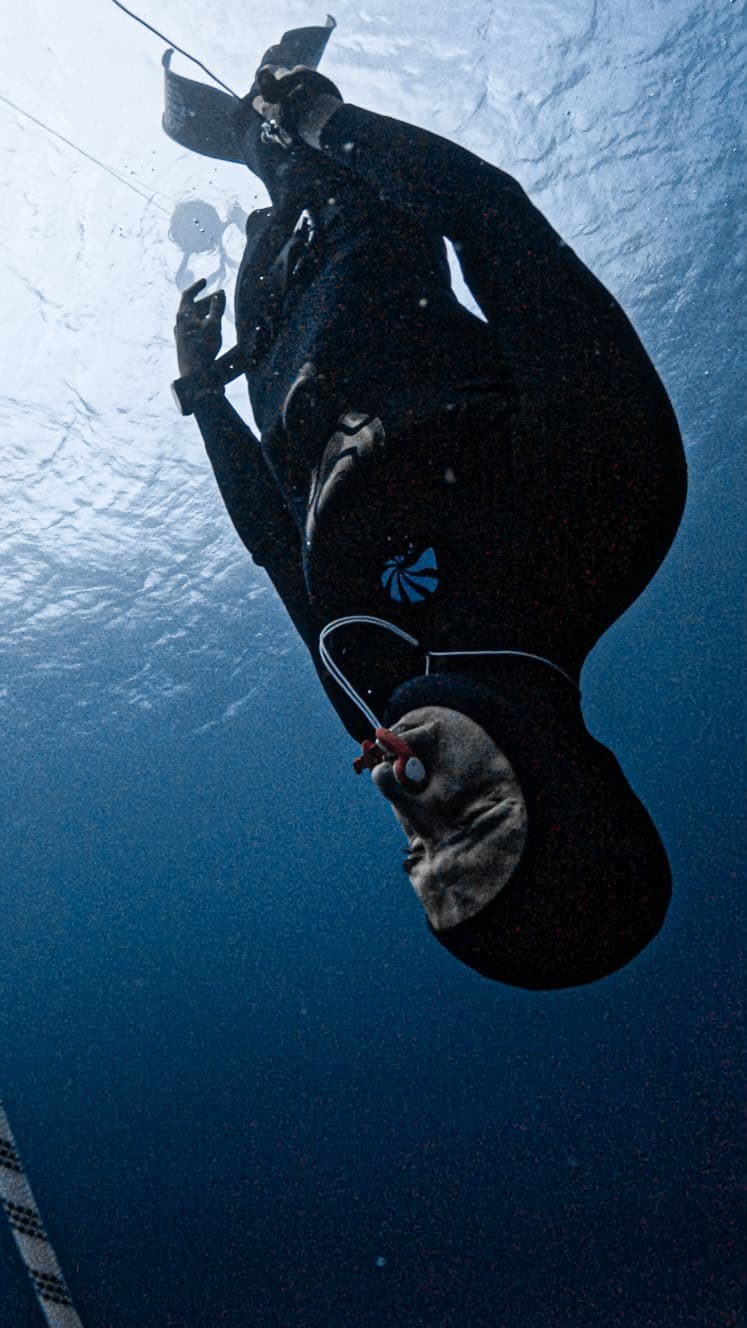
One of the most common questions in freediving is surprisingly simple. “Why can I equalize easily near the surface, but not beyond a certain depth?” For some divers, the problem appears around 25-30 meters. For others, it happens a little bit deeper. The equalization technique feels familiar. The tongue still moves. The nose is pinched. The diver tries again. But suddenly there seems to be no air left to send toward the middle ears. This point has a name. It is called failure depth.
What Is Failure Depth?
From My Experience: Divers often believe their Frenzel technique has suddenly disappeared. In reality, they may simply have reached the pressure at which their lungs can no longer provide usable air to the upper airway in the usual way.
Failure depth is the depth at which normal equalization can no longer continue using air supplied directly from the lungs. Frenzel depends on having enough air available in the lungs and airways to move toward the Eustachian tubes. As you descend, pressure compresses the lungs. Eventually the lungs approach residual volume (Volume of air left in your lungs on land after a full exhale). At that point, drawing more air upward becomes increasingly difficult or impossible without an advanced air-management technique.
The Two Main Factors That Determine Failure Depth
Failure depth depends mainly on two things.
- The quality and fine-tuning of your equalization technique.
A relaxed, precise Frenzel generally works deeper than a tense or partially correct one. A diver who accidentally mixes Frenzel with Valsalva may lose the technique much earlier because abdominal and chest pressure become less effective as the lungs compress.
- The relationship between residual volume and total lung capacity.
Residual volume, or RV, is the amount of air that remains in the lungs after a maximal exhalation. Total lung capacity, or TLC, is the maximum amount of air contained in the lungs after a full inhalation. The smaller the residual volume is in relation to total lung capacity, the greater the theoretical pressure increase the lungs can tolerate before reaching RV.
The Formula for Calculating Theoretical Failure Depth
A simple theoretical estimate is: TLC (liters) ÷ RV (liters) = Failure pressure (absolute bar)
To convert that pressure into an approximate depth in seawater:
Depth in meters ≈ (Failure pressure − 1) × 10
The subtraction of one bar is necessary because we already experience approximately one bar of atmospheric pressure at the surface.
A Practical Example
Imagine a freediver with:
Total lung capacity: 6 liters
Residual volume: 1.5 liters
The calculation is: 6 ÷ 1.5 = 4 bar
Four bar absolute pressure corresponds approximately to 30 meters of seawater.
At 10 meters, the surrounding pressure is about 2 bar.
At 20 meters, it is about 3 bar.
At 30 meters, it is about 4 bar.
According to Boyle’s law, a 6-liter lung volume at the surface would theoretically compress to approximately 1.5 liters at 4 bar.
That is the diver’s residual volume. So the theoretical failure depth is around 30 meters.

Why 30 Meters Is a Useful Reference
In an average untrained adult, residual volume is often roughly 25 percent of total lung capacity. If RV represents one quarter of TLC, then: TLC ÷ RV = 4
This again gives a theoretical failure pressure of 4 bar, or approximately 30 meters. This is an important and encouraging idea. It suggests that, even without specific chest-flexibility training, many healthy adults should theoretically be capable of supplying air for normal equalization to somewhere around 30 meters. But theory and real diving are not identical.
Why Many Divers Fail Much Shallower Than the Formula Predicts
The calculation assumes conditions that rarely exist perfectly in the real world.
It assumes the diver:
Begins with a genuinely full inhalation.
Remains deeply relaxed during descent.
Uses a clean and efficient Frenzel.
Keeps the glottis, soft palate, tongue and jaw coordinated.
Equalizes early and frequently.
Maintains a neutral and consistent head position.
A technical problem can therefore create an apparent failure depth long before the lungs actually reach residual volume. A diver who should theoretically reach 30 meters may struggle at 18 or 20 meters because the available air is being used inefficiently.
Your Frenzel Technique May Not Be as Independent as You Think
How Do You Know If You Are Using Frenzel?
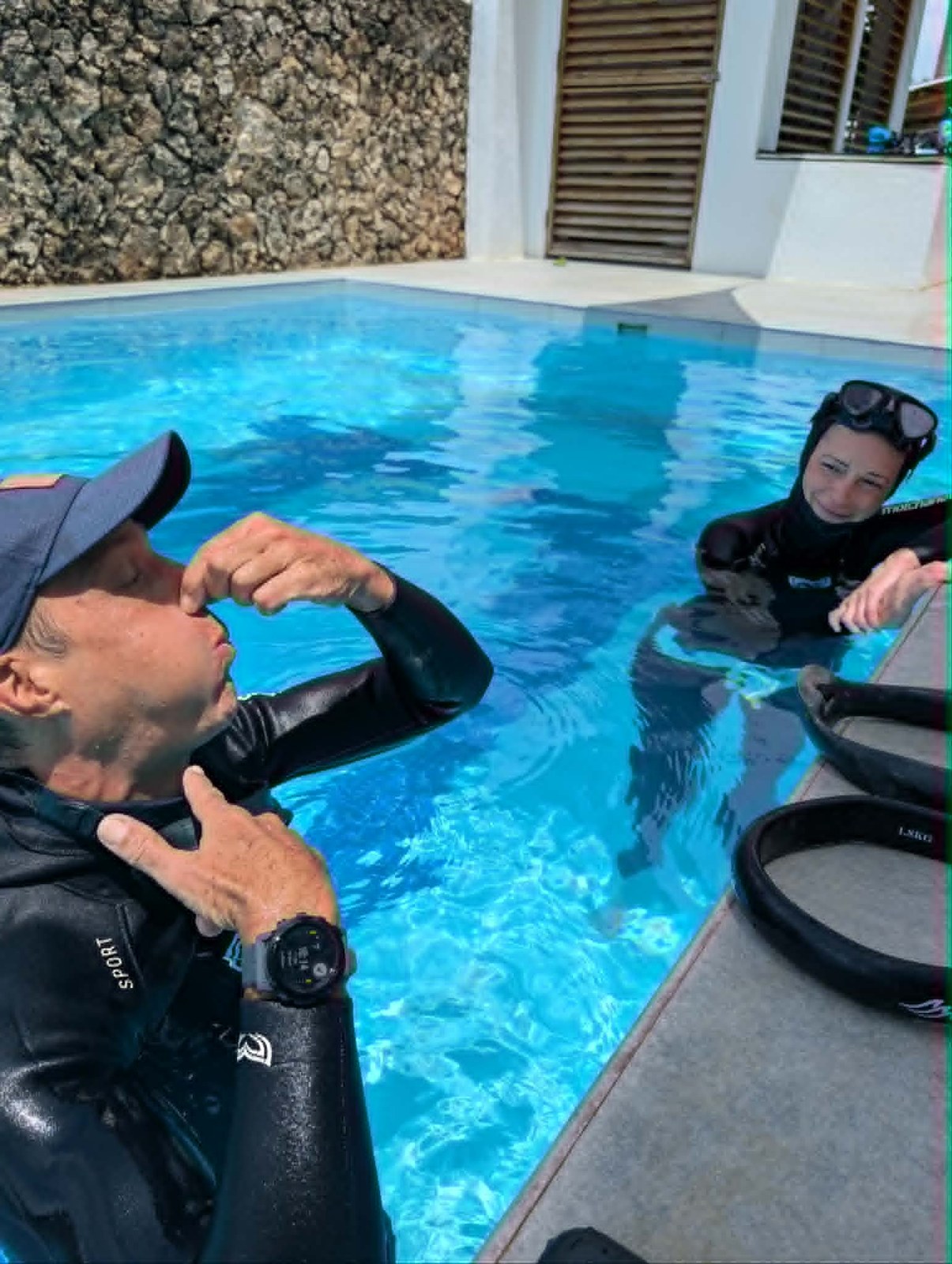
Many divers perform what feels like Frenzel near the surface but still rely partly on pressure from the chest or abdomen. This hybrid technique can work very well at shallow depth. As the lungs compress, however, the contribution from the chest becomes weaker. The diver then feels that Frenzel has suddenly stopped. In reality, the truly independent tongue-piston movement may never have been fully established. This is why dry equalization tests, nose-clip practice, balloon exercises and careful coaching can be so valuable.
Relaxation Changes the Real-World Result
Relaxation Is the Greatest Performance Enhancer in Freediving
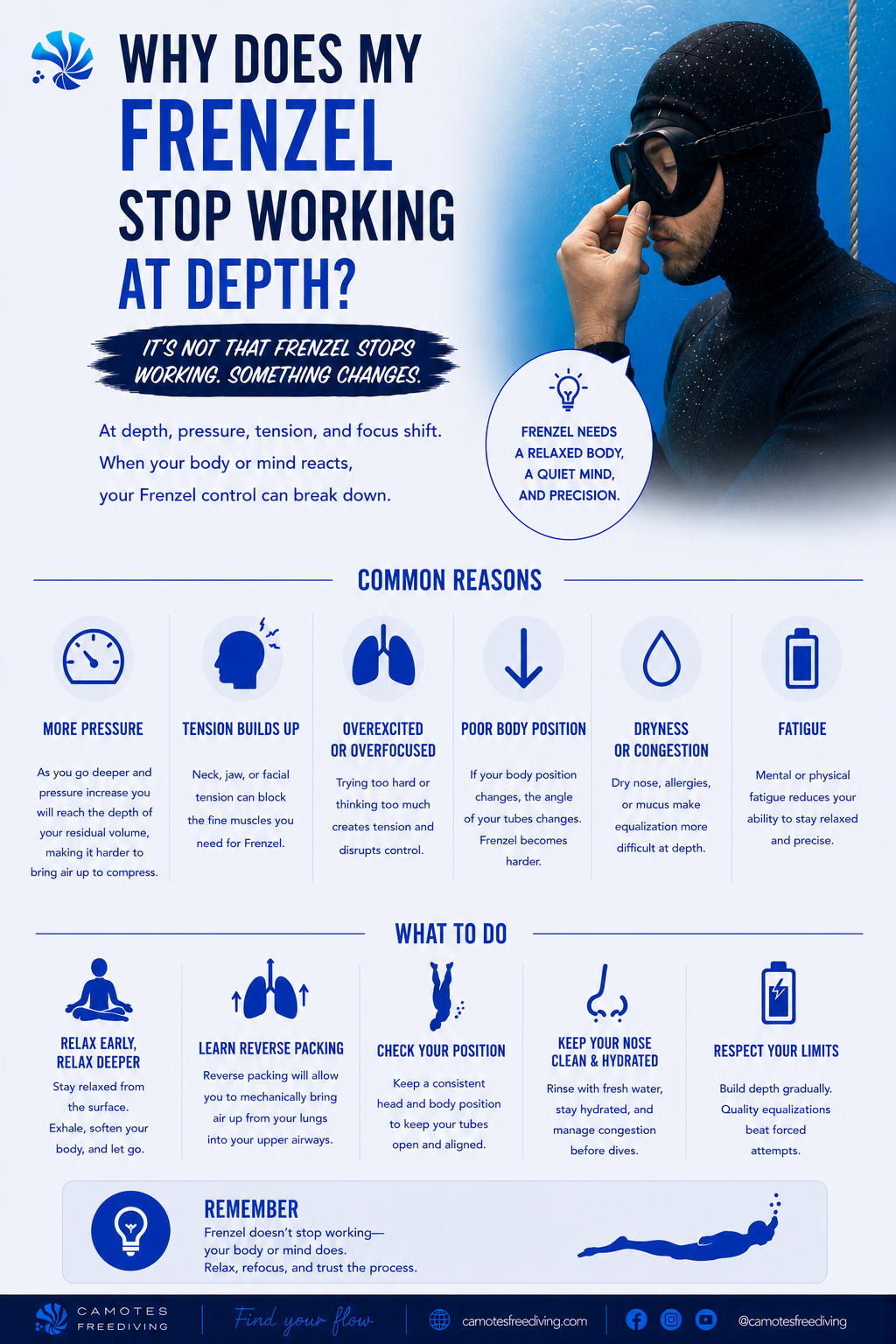
Tension can make a diver reach practical failure depth much earlier. When the neck, jaw, tongue or upper chest tighten, transferring air becomes less efficient. Stress also changes attention. The diver begins thinking about the number on the dive computer. Equalizations become less frequent. The first difficult equalization creates more tension. The next one becomes even harder. This is one reason the same diver may equalize comfortably to 28 meters one day and struggle at 22 meters another day. Their anatomy did not change overnight. Their execution did.
Failure Depth Is Not Necessarily a Permanent Limit
Reaching failure depth does not mean you have reached your final equalization potential. There are several ways progression can continue.
Improve Frenzel efficiency.
Increase comfort and relaxation at depth.
Develop thoracic and diaphragmatic mobility gradually.
Learn to bring air into the mouth before the lungs become too compressed.
The last option leads toward mouthfill.
Why Advanced Divers Learn Mouthfill
Mouthfill changes the source of equalization air. Instead of continuing to draw air directly from increasingly compressed lungs, the diver stores air in the mouth and cheeks before reaching failure depth. That air becomes a separate reservoir. The diver then uses tongue and cheek control to equalize deeper. This is why mouthfill is usually charged before the theoretical failure depth, not after normal equalization has already failed. Once the lungs are at or below residual volume, recovering usable air from them may be extremely difficult. Timing matters. Preparation matters. And a reliable Frenzel remains essential because mouthfill still requires precise control of pressure in the upper airway.
Do Not Rush Into Mouthfill
Many divers hear about failure depth and immediately conclude that they need an advanced technique. Sometimes they do. But often the first priority is simply improving the technique they already have. If your theoretical failure depth is around 30 meters but your Frenzel repeatedly stops at 18 meters, mouthfill may hide the real issue rather than solve it. First make your Frenzel clean. Make it gentle. Make it repeatable. Then learn mouthfill from a strong foundation.
Flexibility Training Can Move Failure Depth Even Deeper
The second major factor influencing failure depth is thoracic flexibility. While a clean Frenzel technique allows you to make better use of the air available, improving your flexibility can actually reduce your residual volume (RV), allowing your lungs to compress further before reaching their physical limit. Just like mastering Frenzel, this is not something that happens overnight. It requires consistent training over months or even years. Fortunately, much of this work can be done entirely on land through exercises such as Uddiyana Bandha, bridges, foam rollers and yoga ball mobility exercises, lung stretching, and Functional Residual Capacity (FRC) diving. To illustrate the potential gains, consider a diver whose residual volume decreases from the average 25% of total lung capacity to 20%. Using the same formula, a diver with a 6-liter TLC would now have an RV of 1.2 liters, giving a theoretical failure pressure of 6 ÷ 1.2 = 5 bar, or approximately 40 meters instead of 30 meters. That’s an increase of about 10 meters, achieved without increasing lung size at all—simply by improving how much the lungs can safely compress. As an example, my own measured residual volume is approximately 11% of my total lung capacity, which theoretically pushes my failure depth far beyond what most recreational freedivers will ever reach.
Failure Depth Is Not the End of Equalization
No matter how small your residual volume becomes, every freediver will eventually reach it. Once your lungs have compressed to their residual volume, there is no longer enough air available to continue normal equalization directly from the lungs. From that point onward, progressing deeper requires either Reverse Packing (used to extract a little more air from the compressed lungs) or, much more commonly, a properly executed Mouthfill prepared before reaching failure depth. Reducing your residual volume therefore does not eliminate the need for advanced equalization techniques—it simply allows you to reach them later. A smaller RV also provides another major advantage: better depth adaptation. Because the lungs tolerate greater compression before reaching their limit, the mechanical stress on lung tissue is reduced, which may decrease the risk of lung squeeze and other pressure-related injuries such as pulmonary edema when combined with appropriate training and conservative progression. In other words, improving flexibility doesn’t just help you equalize deeper—it also helps your body adapt more comfortably and safely to the extreme pressures encountered during deep freediving.
Coach’s Tip: Treat failure depth as an explanation, not a challenge. Equalization difficulty is always a reason to stop the descent, return to a comfortable depth and analyse the technique.
Important Limitations of the Formula
The calculation is useful, but it is not a precise prediction. Real failure depth can be affected by:
How completely you inhale.
Your body position and hydrostatic blood shift.
Diaphragm and chest flexibility.
Air compression in the mask and upper airway.
The accuracy of the measured RV and TLC.
Equalization timing and efficiency.
Stress, fatigue and water conditions.
The formula also simplifies a complex, dynamic process into a static volume calculation. It is best used to understand the principle, not to predict an exact number.
Why You Shouldn’t Chase a Personal Best on Every Training Session
Five Things to Work On Before Your Next Deep Session
- Confirm that you are using a true Frenzel.
Practice without abdominal or chest movement.
- Equalize earlier and more frequently.
Never wait for pressure or discomfort.
- Reduce unnecessary force.
Think of a small, precise pressure pulse rather than a powerful push.
Frequently Asked Questions
What exactly is failure depth?
Failure depth is the pressure or depth at which normal equalization using air supplied directly from the lungs becomes impossible or unreliable because the lungs have compressed toward residual volume.
Which equalization techniques are considered normal equalization?
In this context, normal equalization includes Valsalva, Frenzel and BTV/VTO hands-free equalization. All normally rely on access to air from the lungs and upper airway.
How do I calculate theoretical failure depth?
Divide total lung capacity by residual volume to obtain the theoretical absolute pressure in bar. Then subtract one bar and multiply by roughly ten to estimate depth in meters.
Why does the average calculation give approximately 30 meters?
An average residual volume of about 25 percent of total lung capacity gives a TLC-to-RV ratio of four. Four bar absolute pressure corresponds to approximately 30 meters of seawater.
Does every beginner have to equalize to 30 meters?
No. Thirty meters is only a theoretical reference. Technique, relaxation, anatomy, training and safety all affect practical performance. Divers should never chase this number.
Does reaching failure depth mean I need mouthfill?
Possibly, but first confirm that Frenzel is technically sound. Mouthfill is appropriate when normal equalization is genuinely limited by lung compression, not when a basic technical error is causing early failure.
Can flexibility training change failure depth?
Gradual and appropriate thoracic or diaphragmatic adaptation may allow the body to tolerate greater compression, but it must be approached conservatively. Technique and relaxation should remain the first priorities.
Final Thoughts
When Frenzel stops working at depth, the problem is not always that you have forgotten the movement. Sometimes you have reached a practical technical limit. Sometimes you have reached the point where compressed lungs can no longer provide air efficiently. And sometimes both things happen together. Understanding failure depth helps separate these possibilities.
The simple relationship between total lung capacity and residual volume explains why many untrained adults have a theoretical normal-equalization limit around 30 meters. But the real value of the formula is not the number. It is the understanding behind it. Your lungs are compressing. The available air is becoming smaller. Precision matters more with every meter.
Eventually, better technique is no longer enough and a different air-management strategy becomes necessary. That is where mouthfill begins. Until then, the best progression remains the same. Stay relaxed. Equalize early. Use less force. Master the depth you already have before asking for more.
Further Reading:
What Is Mouthfill?
How to Learn the Frenzel Technique
The Ultimate Guide to Freediving in the Philippines


