

How to Learn the Frenzel Technique: A Step-by-Step Guide for Freedivers

If there is one skill that separates beginner freedivers from advanced freedivers, it probably isn’t breath-holding. It isn’t finning. It isn’t flexibility. It’s equalization. And if there is one equalization technique that every freediver eventually hears about, it’s the Frenzel technique. Unfortunately, it’s also one of the most misunderstood skills in our sport. I’ve met countless students who arrived convinced Frenzel was impossibly complicated. Some had spent weeks watching YouTube videos. Others had read dozens of articles. Many knew all the terminology. Very few actually understood the movement.
The good news? Frenzel isn’t magic. It isn’t a special talent. It’s simply a motor skill. Like riding a bicycle or learning to whistle, it feels strange at first. Then, one day, it becomes automatic.
Before You Learn Frenzel…
Forget About Depth. This is the first mistake many divers make. They try learning Frenzel while descending. That’s like trying to learn to drive on a Formula One circuit. Pressure, buoyancy, relaxation, equalization, finning… Everything is happening at once.
Instead…Learn Frenzel on land first. Water is where you apply the skill. Land is where you build it.
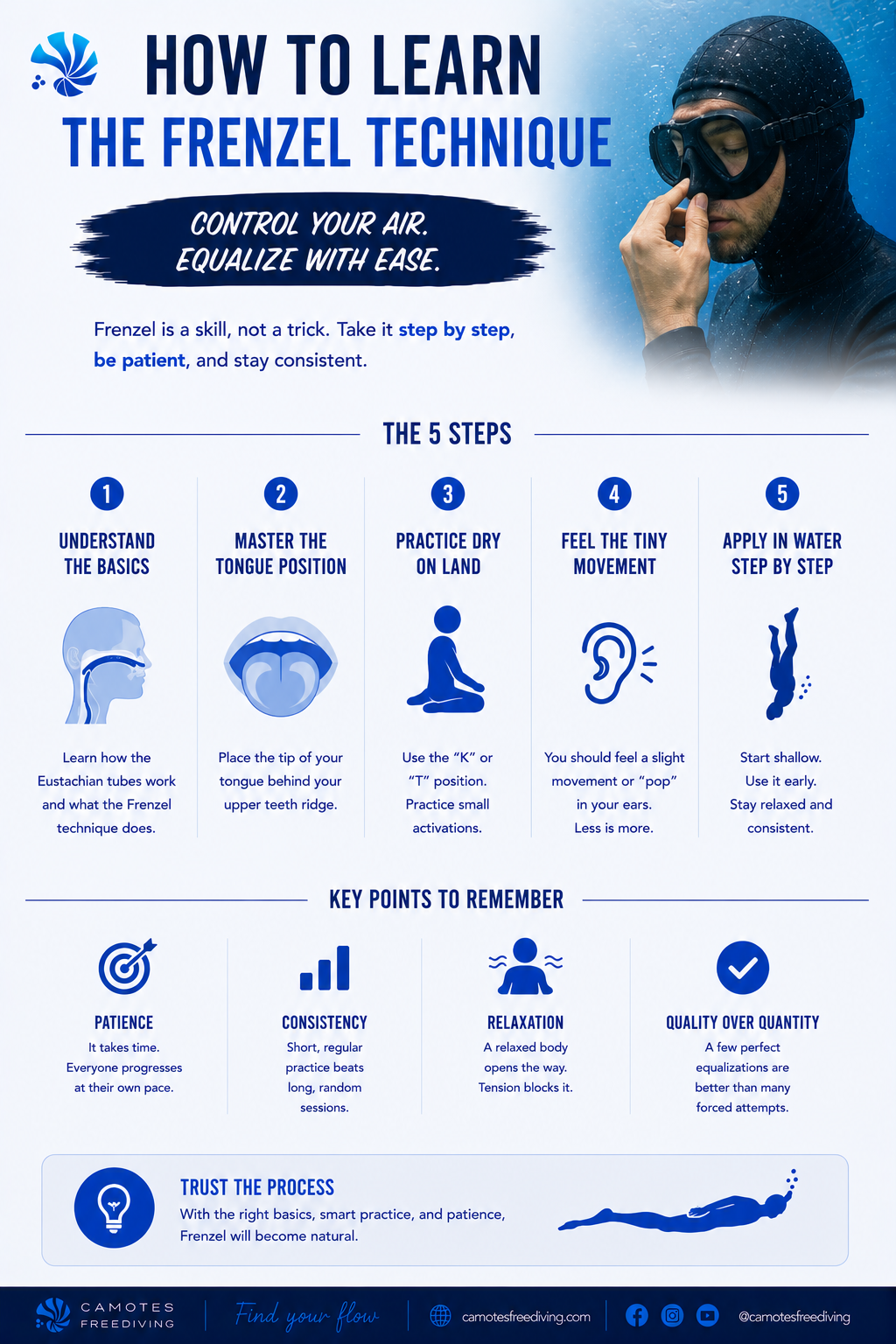

Step 1 – Understand What You’re Trying to Do
Many students think Frenzel is about pushing harder. Actually…It’s almost the opposite. You’re trying to compress a very small volume of air using your larynx. That’s it. Your chest shouldn’t be working. Your abdominal muscles shouldn’t be working. It’s a small movement. Almost delicate.
Step 2 – Learn to Close Your Glottis
This is often the first challenge. Your glottis is the valve that separates your airway from your lungs. During Frenzel, it needs to remain closed. Here’s a simple way to feel it. Pretend you’re about to lift something heavy. You’ll naturally close your glottis. Now relax. Repeat several times. Become aware of the sensation. Awareness always comes before control.
Step 3 – Learn to do a lock with your Tongue
One reason Frenzel feels difficult is that most people have never learned to control their tongue with precision. Spend a few minutes exploring movements.
Put your tongue in a T or K position like if you were about to make the sound.
The goal is to block the air to go in the front of your mouth or in the cheeks.
Don’t rush this step. The better your tongue awareness becomes, the easier everything else will be.
Step 4 – Compress a Small Pocket of Air
Now things begin coming together.
Close your glottis.
Pinch your nose.
Put your tongue in a T or K position
Bring your larynx up to gently compress that air.
(You can imagine you are going from a low pitch sound to a high pitch sound. Put your fingers on your throat, you should feel it moving from down to up.
Alternatively, it also feels as contracting your throat
Your nostrils should be flaring. You should feel your ears equalize. Not through force. Through precision.
What I Tell My Students: Put your hand on your belly/chest. These parts should stay fully relaxed during the whole process
Step 5 – Repeat Without Thinking
Motor skills develop through repetition. Not through understanding alone. You don’t need one hundred different exercises. You need one good movement repeated consistently. Five focused minutes every day is far more effective than one hour every Sunday.
Why Frenzel Feels Impossible at First
Almost everyone goes through the same stages.
Stage One
Nothing happens.
Stage Two
You’re convinced you’re doing it correctly. You’re not.
Stage Three
It works once. You can’t reproduce it.
Stage Four
It becomes inconsistent. Sometimes yes. Sometimes no.
Stage Five
Without noticing… You’re simply equalizing.
This progression is normal. Don’t interpret inconsistency as failure. It’s usually a sign you’re learning.
The Five Biggest Mistakes
- Using Too Much Force
If you’re straining… You’re probably doing too much.
- Holding Too Much Air
Frenzel works best with a relatively small volume of air in your mouth. More isn’t better.
- Practicing Only Underwater
Dry practice accelerates learning enormously.
Coach’s Tip: Daily dry practice will dramatically speed up your progress
- Becoming Frustrated
Frustration creates tension. Tension interferes with movement.
- Changing Exercises Every Day
Choose one good exercise. Repeat it consistently. Mastery comes from repetition.
What If It Doesn’t Work?
This is where many students become discouraged. They think: “Maybe I’m just not capable.” I honestly don’t believe that. After coaching hundreds of divers, I’ve seen too many people eventually succeed. Sometimes the breakthrough comes in ten minutes. Sometimes it takes several days. Both are perfectly normal.

The Value of Good Coaching
One reason equalization is difficult to learn from videos is that tiny mistakes are almost invisible to the person making them. A coach standing beside you often notices immediately if you’re using your chest, your glottis opened, your jaw became tense, your tongue didn’t do a proper block. Small corrections can save weeks of frustration. That’s why I still believe coaching is one of the fastest ways to learn Frenzel.
How Long Does It Take?
This is probably the question I hear most. The honest answer? It depends. Some students understand Frenzel during their first lesson in the water. Others need a bit more practice. I believe with a proper teaching of the skill, almost everyone gets it at least on dry in their first lesson.
I’ve even seen experienced scuba divers take longer than complete beginners because they had to replace years of Valsalva habits. Everyone learns differently. Don’t compare timelines.
When Should You Start Using Frenzel Underwater?
Only when the movement feels reasonably consistent on land. You don’t need perfection. But you do need familiarity. Once you understand the movement… Begin practicing in shallow water where there’s no pressure to perform. Build confidence before building depth.
Frequently Asked Questions
Can everyone learn Frenzel?
In my experience, everyone can. It is a motor skill, not a talent.
Should Frenzel feel powerful?
No. It should feel precise. Gentle. Efficient.
How long should I practice every day?
Five to ten focused minutes is usually enough. Consistency matters much more than long practice sessions.
Why does Frenzel work on land but not underwater?
Because underwater you’re also managing pressure, buoyancy, body position, relaxation, and timing simultaneously.
Why Can I Equalize on Land but Not Upside Down?
Is it worth taking a course just to learn Frenzel?
Absolutely. Equalization is one of the hardest skills to self-diagnose, and a qualified instructor can often identify problems that are almost impossible to notice on your own.
Final Thoughts
Learning Frenzel can feel frustrating. Until suddenly… It doesn’t. One day you’ll realize you’re no longer thinking about your tongue. Or your glottis. Or your soft palate. You’ll simply equalize. That’s when the movement has truly become yours. And perhaps that’s the biggest lesson Frenzel teaches. Mastery rarely arrives all at once. It arrives quietly. One repetition at a time. One small improvement after another. Until something that once felt impossible becomes completely natural. That’s true for equalization. And, in many ways… It’s true for freediving itself.
Further Reading:
How to Equalize Your Ears for Freediving
How to Learn the Frenzel Technique
How Do You Know If You Are Using Frenzel?


