

Static vs Dynamic vs Depth Freediving: Understanding the Different Disciplines
One of the funniest conversations I regularly have goes something like this. Someone discovers I’m a freediver. They immediately ask: “So… how long can you hold your breath?” Then I answer. And they assume that’s what freediving is. Just holding your breath. The reality is much more interesting. Freediving isn’t one discipline. It’s a family of disciplines. Some happen in a swimming pool, some happen in the ocean. Some reward stillness, others reward efficiency, and others require incredible technical precision. They’re all freediving. But they each teach you something different.
Freediving Is Like Athletics
Imagine saying: “I do athletics.” The next question would probably be: “Which event?” Sprint? Marathon? High jump? Pole vault? They’re all athletics… But they’re completely different sports. Freediving works exactly the same way. There are several disciplines, each with its own challenges and rewards.
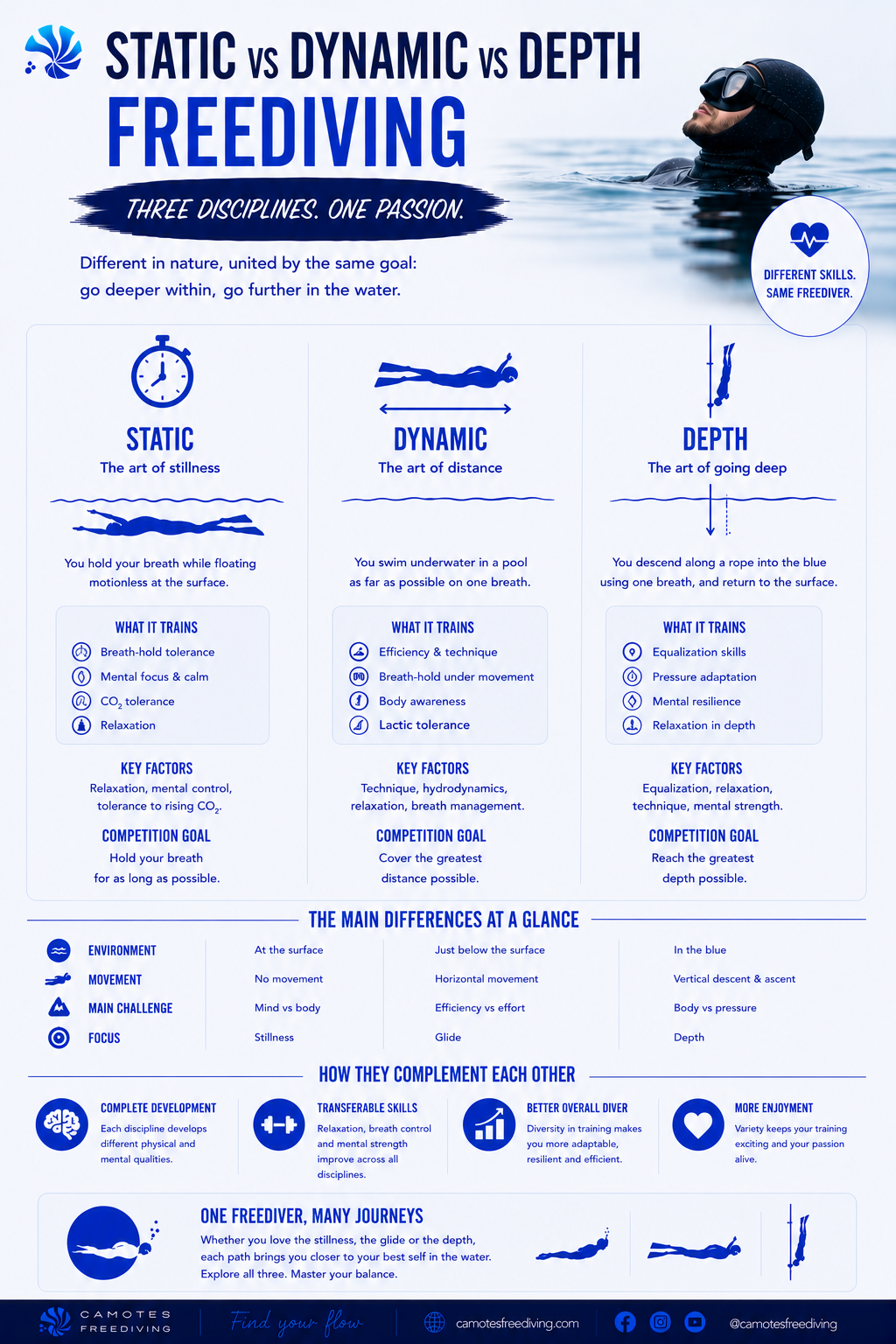

Static Apnea (STA)
Static apnea is probably the simplest discipline to understand. You hold your breath. And you don’t move. Usually you’re floating face down in calm water while a trained buddy supervises you. That’s it. No swimming. No descending. No finning. Just stillness. Simple doesn’t mean easy. Static apnea is often described as the purest mental discipline in freediving. Without movement to distract you, you’re left alone with your thoughts.
How to Improve Your Breath Hold
What Static Teaches You
Many beginners think static apnea is only about holding your breath longer. I don’t see it that way. Static teaches relaxation, patience, body awareness, mental control and acceptance. Some of the best lessons I’ve learned about freediving happened while completely motionless.
Dynamic Apnea (DYN)
Dynamic apnea takes place in a swimming pool. Instead of staying still… You swim as far as possible on one breath. Unlike static, movement now becomes part of the challenge. Every kick costs oxygen. Every unnecessary movement has a price. Dynamic rewards efficiency more than strength.
Dynamic With Fins
The most common version uses bi-fins or a monofin. A good finning technique makes an enormous difference. Watching experienced monofin athletes is almost hypnotic. Everything flows. Nothing appears forced. They’re moving through the water rather than fighting it.

Dynamic Without Fins
This is one of my favourite disciplines to watch. No fins. Just the body. Every movement must be efficient. Technique becomes everything. Many divers discover flaws in their streamlining during no-fin swimming because there’s nowhere to hide.

What Actually Makes Someone Better?
After teaching hundreds of students, I would say improvement usually comes from: Learning to relax, understanding equalization, moving more efficiently, building confidence, developing consistency. Very few breakthroughs come from simply forcing yourself to hold your breath longer.
Depth Disciplines
When most people imagine freediving, this is what they picture. A diver descending into the blue. One breath. One line. One continuous journey downward. Depth disciplines are what first attracted me to freediving. Even after all these years, I still think there’s something magical about descending silently through open water.

Constant Weight (CWT)
Constant Weight is probably the best-known depth discipline. You descend and ascend using your fins. The weight you start with is the weight you finish with. No pulling on the rope. No dropping weights. Small improvements in technique can produce surprisingly large improvements in performance.
Constant Weight Without Fins (CNF)
Many divers call CNF the purest depth discipline. No fins. No pulling. Just your body. Every meter must be earned through efficient movement. It’s beautiful. It’s demanding. And it’s incredibly technical.
Free Immersion (FIM)
This is my own favourite discipline. Instead of using fins, you pull yourself along the line using your arms. To many people, that sounds easier. In reality… It requires exceptional rhythm, precision and relaxation. One reason I love Free Immersion is that it feels incredibly connected. Every movement gives immediate feedback. Every mistake becomes obvious. Every improvement feels rewarding. After years of training, it became the discipline where I eventually reached more than 130 meters, and I still find it endlessly fascinating.
Pool and Depth Teach Different Skills
People sometimes ask me which discipline is the best. I honestly don’t think there is one. Pool disciplines develop breath-hold comfort, efficiency, mental strength, technique. Depth disciplines develop equalization, pressure adaptation, open-water confidence, freefall. They’re complementary. Training both often makes you a better overall freediver.
Coach’s Tip: If you want to become a better depth diver, spend some time improving your pool skills too.
Competitions
Competitive freediving includes both pool and depth events.
Pool competitions usually feature:
- Static Apnea (STA)
- Dynamic With Fins (DYN)
- Dynamic Bi-Fins (DYNB)
- Dynamic Without Fins (DNF)
Depth competitions include:
- Constant Weight (CWT)
- Constant Weight Bi-Fins (CWTB)
- Constant Weight Without Fins (CNF)
- Free Immersion (FIM)
Each discipline attracts athletes with different strengths. Some excel in stillness. Others in movement. Others under pressure. And others are all around freedivers performing in all fields
Which Discipline Is Best for Beginners?
For most people… The answer is simple. Don’t choose. Experience them all. A beginner freediving course introduces several aspects of the sport while building the foundation that applies everywhere. Only later do most divers discover which discipline speaks to them most.
From My Experience: Every discipline teaches something valuable. Don’t ignore one because another happens to be your favourite.
What Each Discipline Has Taught Me
Static taught me patience. Dynamic taught me efficiency. Depth taught me humility. And Free Immersion taught me trust. That’s one of the reasons I love freediving so much. Different disciplines. Different challenges. Different lessons. Yet they’re all pointing toward the same thing: Becoming calmer, more aware, more efficient.
Five Reasons to Try Different Disciplines
- They improve one another.
Skills developed in one discipline often transfer surprisingly well to another.
- They prevent boredom.
Variety keeps training enjoyable.
- They reveal weaknesses.
Each discipline exposes something different.
- They build complete divers.
Not just specialists.
- They’re all fun.
Sometimes that’s reason enough.
Frequently Asked Questions
What’s the easiest freediving discipline for beginners?
Most beginners start with static apnea, dynamic pool training and shallow depth sessions during their first course. Each develops different skills in a safe, progressive way.
Which discipline is the deepest?
Today, the deepest competitive disciplines are Constant Weight and Free Immersion, while No Limits has historically reached the greatest absolute depths but is no longer part of modern competition.
Is static apnea useful for depth diving?
Absolutely. Static develops relaxation, breath awareness and mental control that transfer directly to open-water diving.
What’s the difference between Constant Weight and Free Immersion?
In Constant Weight you use fins to descend and ascend. In Free Immersion you pull yourself along the rope using your arms instead of fins.
Do I need to choose one discipline?
Not at all. Most freedivers enjoy training several disciplines, especially early in their progression.
Final Thoughts
When people first discover freediving, they often think it’s a sport with one objective: Hold your breath. The longer I practice… The less I believe that’s true. Freediving isn’t one discipline. It’s many different conversations with the water. Sometimes you’re completely still. Sometimes you’re gliding through a pool. Sometimes you’re descending into the blue. Every discipline teaches something unique. But all of them ultimately lead toward the same destination. A better understanding of your body, a quieter mind, and a deeper appreciation for what humans are capable of on a single breath.
For me, that journey happened through Free Immersion. For you… It might begin somewhere completely different. And that’s one of the beautiful things about freediving. There’s more than one path beneath the surface.
Further Reading:
Training for Deep Freediving
Why Serious Freedivers Choose Camotes for Training
The Ultimate Guide to Freediving in the Philippines


