

The Spleen Effect: Your Body’s Natural Blood Doping for Freediving
If I asked you which organ helps you hold your breath longer… Most people would probably answer: “The lungs.” It’s a reasonable guess. After all, breath-holding seems to be all about the lungs. But surprisingly, one of the most important organs for freediving isn’t your lungs at all. It’s your spleen. In fact, hidden inside your abdomen is an organ that quietly stores millions of extra red blood cells. And during repeated breath holds… It gives them back to you. Almost like a biological reserve tank. It’s one of the most fascinating physiological adaptations in freediving. And yet, very few people know it exists.
What Does the Spleen Actually Do?
The spleen is located on the left side of your upper abdomen, just beneath your rib cage. Most people never think about it. It’s quietly involved in several important functions:
- Filtering old red blood cells.
- Supporting the immune system.
- Storing platelets.
- And, perhaps most interesting for freedivers…
Acting as a reservoir for red blood cells. Think of it as a small warehouse. Most of the time, those extra red blood cells simply wait. Then, when your body senses repeated breath holds… The warehouse opens.


Why Red Blood Cells Matter
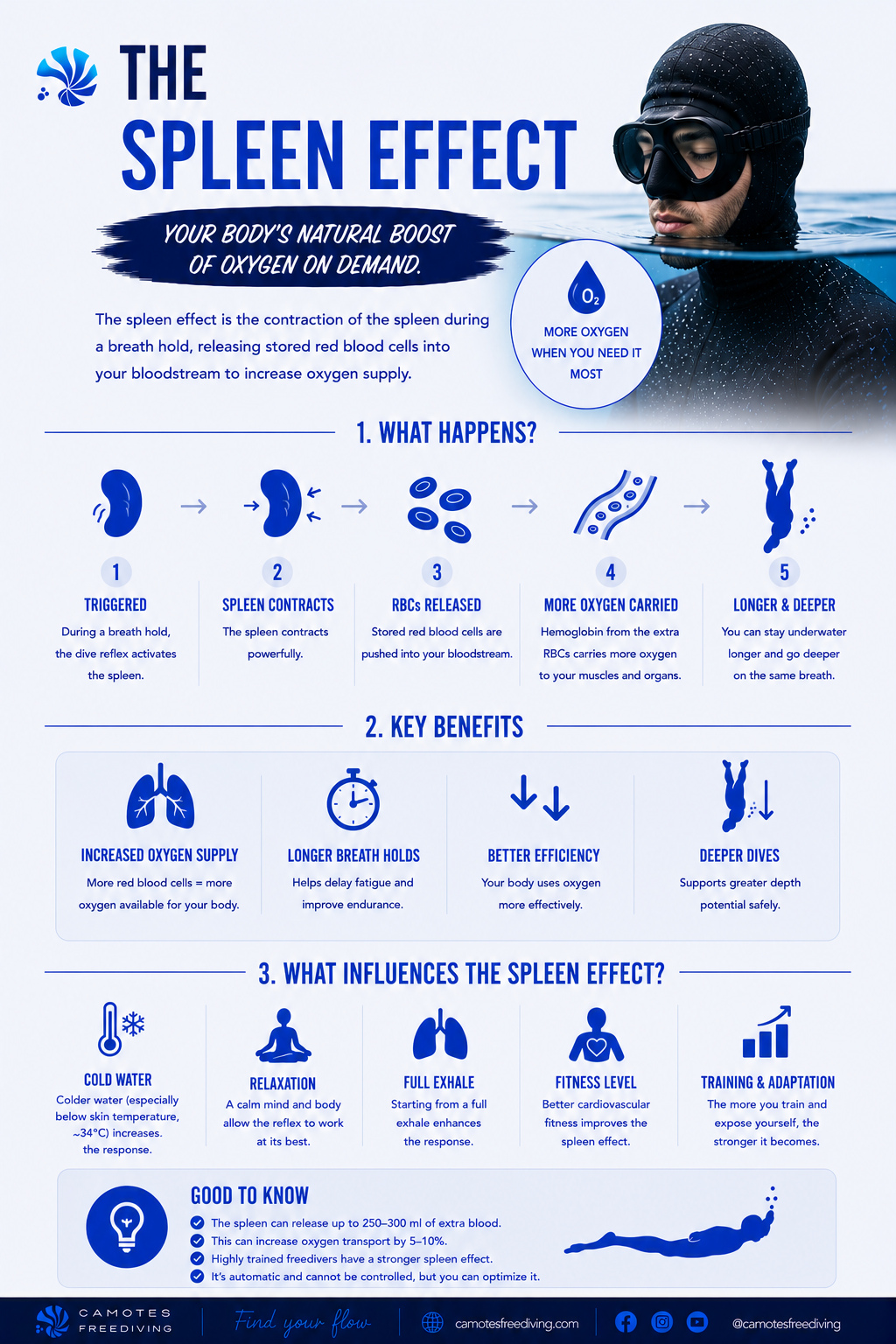
Red blood cells transport oxygen. The more red blood cells circulating in your bloodstream… The greater your body’s ability to carry oxygen. That doesn’t necessarily mean you’ll instantly double your breath hold. But it does mean your oxygen transport system becomes temporarily more efficient. Your body is making better use of the oxygen you’ve already stored.
What Is the Spleen Effect?
During repeated breath holds, your spleen gradually contracts. As it contracts, it pushes stored red blood cells into circulation. This process is known as the spleen effect or splenic contraction. It’s one of the body’s natural responses to breath-holding. And remarkably… It’s completely automatic. You don’t decide to activate it. Your body does it for you.
Nature’s Own Blood Doping
People sometimes describe the spleen effect as natural blood doping. I actually think that’s a good comparison. Unlike artificial methods that increase red blood cells over weeks or months… The spleen can temporarily increase the number of circulating red blood cells within minutes. Nothing artificial. Nothing dangerous. Just another remarkable adaptation that evolution quietly gave us.


When Does It Happen?
One of the questions I hear most often is: “After how many breath holds does the spleen contract?” The honest answer is: It varies. There isn’t a magic number. Most research suggests that repeated breath holds over several minutes progressively stimulate splenic contraction. In practice, many freedivers notice the effects during their warm-up routine.
Personally, one thing I’ve often observed during training is that the first splenic contraction feels like the strongest. After a few warm-up dives, something changes. The dives begin to feel easier. Relaxation improves. The urge to breathe often arrives later. Whether that’s entirely due to the spleen or partly to other adaptations is difficult to say, but it’s a sensation many experienced freedivers recognize.
Can You Feel It?
Some divers report a subtle sensation beneath the left rib cage. Others feel nothing at all. Personally, I don’t think trying to “feel” your spleen is particularly useful. The important point is that the physiological adaptation is happening whether you’re aware of it or not. Freediving is full of processes that occur silently. The spleen effect is one of them.
Does It Really Improve Performance?
Yes. Research has shown that splenic contraction can increase the concentration of circulating red blood cells by several percent. That might not sound dramatic. But in a sport where tiny improvements matter… It’s significant. More oxygen transport means slightly more available oxygen during your dive. Elite performance is often built on small advantages accumulated together.
Why Warm-Up Matters
This is one reason experienced freedivers rarely begin a deep dive completely “cold.” Warm-up dives aren’t only preparing your technique. They’re also preparing your physiology. Your nervous system settles. The Mammalian Dive Reflex strengthens. And your spleen begins contributing additional red blood cells. Everything gradually becomes more efficient.
From My Experience: Many freedivers notice they feel better after a few dives. That’s one reason I rarely judge my performance on the very first dive of the day.
The Spleen Doesn’t Replace Good Technique
Here’s an important point. Some people hear about the spleen effect and think: “Great. My body will do the work for me.” Not quite. The spleen helps. But it doesn’t replace good , equalization, relaxation, efficient finning, proper training, safe diving practices. It’s one piece of a much larger puzzle.
Relaxation Is the Greatest Performance Enhancer in Freediving
The Incredible Connection Between Evolution and Freediving
One of the reasons I love teaching physiology is that it changes the way people see themselves. The spleen wasn’t designed specifically for competitive freediving. It evolved because mammals repeatedly faced situations where conserving oxygen improved survival. Freediving simply reveals capabilities that have always existed. That idea never stops amazing me.
Can You Train the Spleen?
To some extent, yes. Like many aspects of the dive reflex, repeated exposure to breath-holding appears to make the response more effective. Experienced freedivers often develop stronger and more consistent splenic contractions than complete beginners. But it’s important to remember: You aren’t training the spleen directly. You’re training your body to express a natural adaptation more efficiently.
How Often Should You Train Freediving
Don’t Obsess Over It
One thing I’ve noticed in freediving is that people sometimes become fascinated by advanced physiology. That’s understandable. It’s fascinating. But remember: The spleen effect won’t compensate for poor technique or poor relaxation or poor safety. It’s a bonus. Not the foundation. Build the fundamentals first. The physiology will support them.
My Own Experience
Over the years, I’ve become increasingly aware of how much my body changes during a training session. The first few dives always feel different. Everything gradually settles. Breathing becomes quieter. Movements become smoother. The urge to breathe changes. Whether that’s the dive reflex… The spleen… Improved relaxation… Or simply familiarity with the water… It doesn’t really matter. What matters is understanding that your body is adapting. That’s why I never judge my diving based on the very first descent of the day. Sometimes your body simply needs a little time to remember what it’s built to do.
Coach’s Tip: Build progressive warm-ups into your sessions instead of expecting peak performance immediately.
Five Practical Takeaways
- Don’t skip your warm-up.
Your physiology needs time to adapt.
- Be patient.
The first dive isn’t always the best one.
- Stay relaxed.
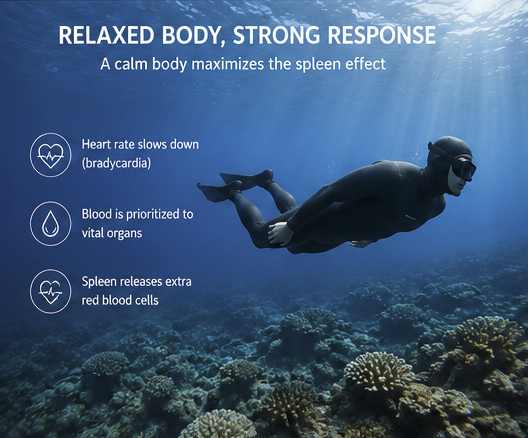
Relaxation enhances many components of the dive reflex.
- Train consistently.
Regular exposure helps your body become more efficient.
- Trust your biology.
Your body is working with you—not against you.
Frequently Asked Questions
What is the spleen effect?
It’s the natural contraction of the spleen during repeated breath holds, releasing stored red blood cells into circulation to improve oxygen transport.
Does everyone experience splenic contraction?
Yes, although the strength of the response varies between individuals.
Can the spleen effect improve breath holds?
It contributes to improved oxygen transport, but it’s only one factor among many that influence breath-hold performance.
Should I do warm-up dives to activate the spleen?
Warm-up dives help prepare both your physiology and your technique. They should always be done conservatively and according to safe freediving practices.
Is the spleen effect permanent?
No. The increase in circulating red blood cells is temporary. Over time, the spleen gradually returns to its normal state.
Final Thoughts
One of the reasons I continue to love freediving after all these years is that it constantly reminds me how intelligent the human body really is. We often think of performance as something we create through effort. But many of the greatest adaptations happen quietly. Without force. Without conscious control. A slower heartbeat. Smarter circulation.
A contracting spleen releasing hidden reserves of oxygen-carrying cells exactly when they’re needed. Millions of years of evolution are working in your favor every time you take a breath, relax, and descend beneath the surface. The spleen effect is a beautiful reminder that freediving isn’t about fighting your biology. It’s about giving your biology the opportunity to do what it has always known how to do. And perhaps that’s one of the greatest lessons this sport can teach us. Sometimes, extraordinary performance comes not from adding something new… But from allowing something ancient to awaken.


