

Is Freediving Dangerous? Understanding the Real Risks and How to Dive Safely

Whenever I tell someone I’m a professional freediver, I can almost predict the next question. They look at me with a mixture of curiosity and disbelief and ask: “Isn’t that dangerous?” It’s a fair question. Holding your breath underwater sounds risky. Diving to depth sounds even riskier.
Movies often portray freediving as an extreme sport where athletes constantly flirt with disaster. The reality is far more nuanced. Yes, freediving carries risks. So does driving a car. So does climbing a mountain. So does swimming in the ocean. The real question isn’t whether freediving is dangerous. It’s how those risks are managed.
Every Activity Has Risks
It’s easy to label something as dangerous simply because it’s unfamiliar. But risk isn’t unique to freediving. Cycling, rock climbing, scuba diving, surfing. even hiking. All involve some level of risk. The difference is that experienced participants understand those risks and know how to reduce them. Freediving is no different. The sport has evolved enormously over the last two decades, and today’s training standards place safety at the center of everything we do.
The Biggest Risk Isn’t Holding Your Breath
This surprises many beginners. Most people assume the greatest danger comes from running out of oxygen. In reality, the biggest risks usually come from poor decision-making: Ignoring proper training, diving alone, skipping safety procedures, hyperventilating, progressing too quickly… Almost every serious accident in freediving involves one or more avoidable mistakes. That should be reassuring. Because good decisions dramatically reduce risk.
The Number One Rule
If you remember only one thing from this article, let it be this: Never freedive alone. Ever. Not in a pool, not in the ocean, not even if the water is shallow. A trained buddy is the most important piece of safety equipment you’ll ever have. Equipment can fail. Conditions can change. Your buddy is there to recognize problems before they become emergencies and to respond immediately if needed. It’s the rule that every experienced freediver respects.
Training Makes the Difference
One of the biggest misconceptions is that freediving is simply about holding your breath. A good beginner course teaches far more than that. You learn: How to breathe properly, how to equalize safely, how to recognize your limits, how to rescue another diver, how to plan dives, how to recover correctly at the surface… Those skills aren’t optional. They’re what make freediving a safe activity.
What Happens During Your First Freediving Course
The Ocean Doesn’t Reward Ego
I’ve always believed that one of the greatest dangers in freediving isn’t depth. It’s ego. Trying to impress someone. Ignoring warning signs. Continuing because “just one more dive.” The ocean has a way of reminding us that confidence and overconfidence are very different things. The best freedivers I know aren’t reckless. They’re disciplined.

Respect Your Limits
One thing I tell every student is: Your limit today is the right limit for today. There’s no prize for forcing another five meters. No reward for ignoring discomfort. Freediving isn’t about proving something. It’s about exploring safely. The ocean will still be there tomorrow.

Good Safety Looks Boring
People often imagine safety as something dramatic. Rescue drills, emergency oxygen, accidents. Actually… The safest freediving days are wonderfully uneventful. Because everyone follows simple procedures consistently :
- Buddy positioning.
- Surface protocols.
- Clear communication.
- Proper supervision.
When those habits become automatic, the entire sport becomes much safer.
Experience Doesn’t Replace Discipline
One of the most dangerous thoughts a diver can have is: “I’ve done this hundreds of times.” Experience is valuable. But it should increase humility—not reduce it. The best athletes in the world still follow checklists. Still brief their safety teams. Still respect procedures. That’s not because they’re inexperienced. It’s because they understand that discipline keeps them alive.
Depth Doesn’t Create Danger
One Mistake I See Often: People fear depth more than poor decision-making. In reality, good habits are what keep divers safe.
This is another misconception. People often assume deeper automatically means more dangerous. In reality, a poorly supervised dive to 10 meters can be far riskier than a well-planned dive to 60 meters with an experienced team. Depth is only one factor. Preparation, training, conditions, supervision, decision-making. Those often matter much more.


Safety Is a Skill
Just like equalization. Just like finning, just like relaxation… Safety is something you practice. You rehearse rescues. You learn surface protocols. You develop good habits. The more automatic those habits become, the more attention you can devote to enjoying the dive itself.
My Own Perspective
People sometimes assume that because I dive beyond 130 meters, I must enjoy taking risks. The truth is almost the opposite. The deeper I’ve gone, the more conservative I’ve become. Because I understand how much preparation sits behind every successful dive. World-class performances don’t happen because someone ignores risk. They happen because every possible risk has been anticipated, discussed and managed. That’s one of the biggest lessons competition has taught me.
From My Experience: The safest freedivers I know are also the least interested in impressing others.
Why Proper Instruction Matters
Could you teach yourself freediving from YouTube? Maybe. But would you know if you’re developing unsafe habits? Would you recognize a blackout? Would you know how to rescue a buddy? Would your buddy know how to rescue you? A qualified instructor doesn’t just teach techniques. They teach judgment. And judgment is one of the most valuable skills you’ll ever develop underwater.

Five Ways to Make Freediving Safer
- Never dive alone.
Always dive with a trained and attentive buddy.
- Take a proper freediving course.
Good instruction builds good habits from the very beginning.
- Respect your limits.
Progress gradually and never let ego make decisions.
- Follow surface protocols.
Recovery begins when the dive ends.
- Stay curious.
Continue learning. The safest freedivers never stop improving.
Frequently Asked Questions
Is freediving dangerous?
Like many outdoor sports, freediving carries risks. With proper education, buddy procedures and sensible progression, those risks can be significantly reduced.
Is freediving safer after taking a course?
Yes. A quality course teaches essential safety skills, rescue techniques and good habits that recreational divers are unlikely to learn on their own.
Can beginners learn freediving safely?
Absolutely. Beginner courses are specifically designed to introduce the sport gradually under close supervision.
Is diving alone ever acceptable?
No. Experienced freedivers around the world agree on one principle: never freedive alone.
What’s the biggest cause of accidents?
Most serious accidents involve poor decisions such as diving alone, inadequate supervision, hyperventilation or exceeding one’s level of training.
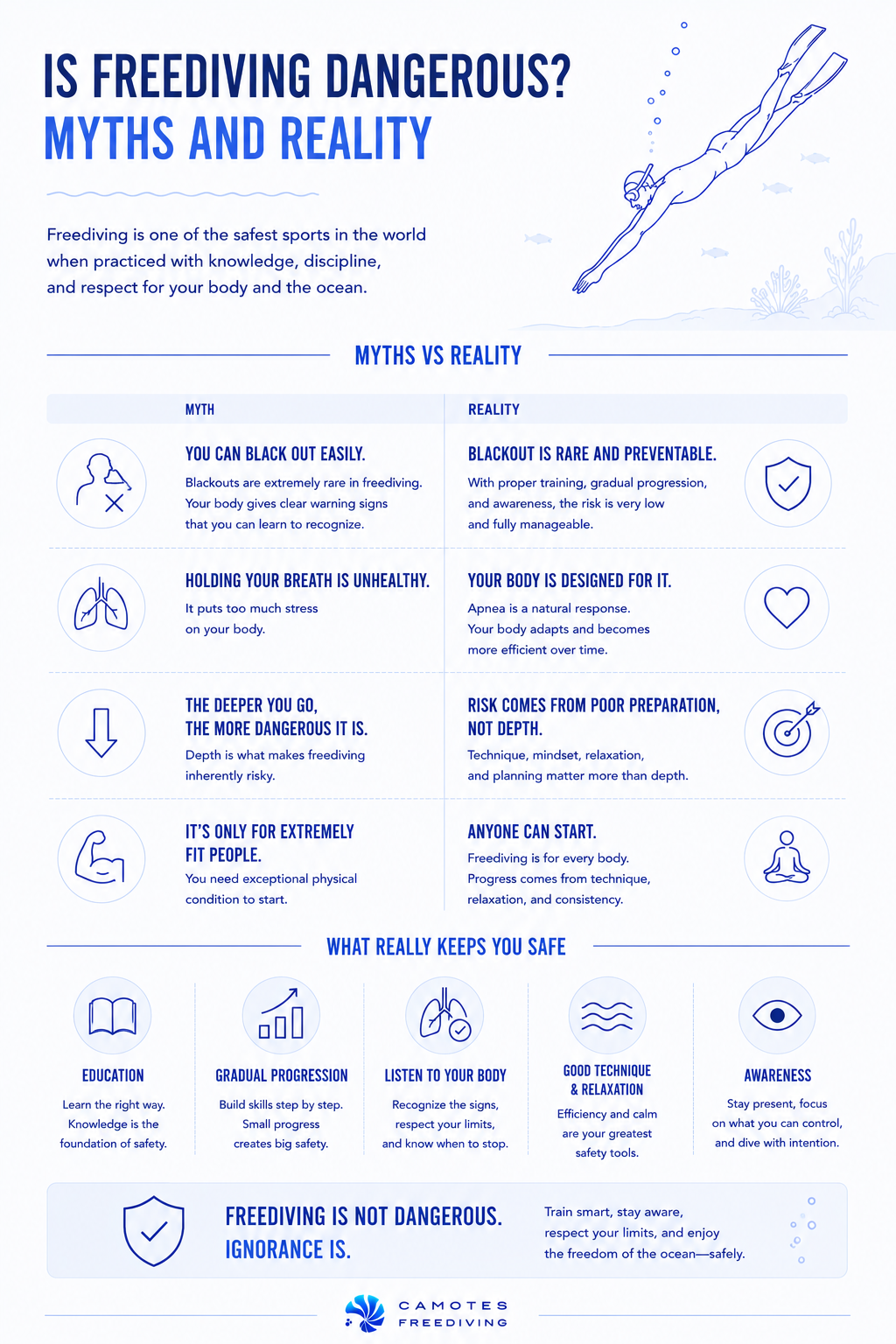
Final Thoughts
People often ask me whether freediving is dangerous. I think a better question is: “Can freediving be practiced responsibly?” The answer is absolutely yes. After thousands of dives, one thing has become very clear to me. The safest freedivers aren’t necessarily the strongest. Or the deepest. Or the most experienced. They’re the ones who never stop respecting the ocean. Who never stop following simple procedures. Who never allow confidence to replace discipline. That’s the kind of freediver I still aspire to be. Because in the end, success in freediving isn’t measured by the deepest dive you’ve ever done. It’s measured by being able to enjoy the ocean safely for the rest of your life.
Further Reading:
How to Progress Safely in Freediving
Why Camotes Freediving Is More Than Just a Freediving School
The Ultimate Guide to Freediving in the Philippines


