What Happens to Your Body as You Dive Deeper? The Amazing Physiology of Pressure
One of the reasons I fell in love with freediving is that every dive feels like a conversation with physics. The deeper you go… The more the environment changes. Pressure increases. Your lungs become smaller. Your body begins adapting in remarkable ways.
At first glance, this might sound frightening. How could a human body possibly tolerate depths of 30…60… 100 meters…Or even deeper? The answer is simple. Because the human body is far more adaptable than most people realize. Let’s take a journey from the surface into the deep and explore what really happens.
What Happens to Your Body at 10m, 30m, 50m and 100m
The Surface
Everything begins here. Your lungs are completely full. Your ears contain air at atmospheric pressure. Your heart beats normally. Your body is relaxed. At this point, nothing feels unusual. But the moment you leave the surface… Everything begins changing.
The First Ten Meters
The first ten meters are actually where the biggest pressure change occurs. At the surface, you’re under 1 atmosphere (1 ATA) of pressure. At 10 meters, you’re under 2 atmospheres (2 ATA). That means the pressure has doubled. Many beginners assume pressure increases gradually. Physiologically… The biggest relative changes happen near the surface. That’s why equalization is so important early in the dive.
Your Ears
The very first thing most divers notice is pressure inside the ears. As external pressure increases, the eardrums begin bending inward. Unless you equalize… Discomfort appears quickly. This isn’t your body failing. It’s simply physics. By adding air into the middle ear, you restore balance. That’s why experienced freedivers equalize early and often.
How to Equalize Your Ears for Freediving
Your Lungs Become Smaller
This surprises many beginners. Your lungs don’t resist the pressure. They adapt to it. According to Boyle’s Law, the volume of a gas decreases as pressure increases. At 10 meters… The air inside your lungs occupies roughly half the volume it did at the surface. At 20 meters… Roughly one third. At 30 meters… Around one quarter. Your lungs aren’t disappearing. The air inside them is simply being compressed.
Your Buoyancy Changes
Because your lungs contain less air as you descend… You also become less buoyant. Near the surface you float easily. Deeper down, the ocean begins helping you descend. Eventually, many freedivers reach a point where they stop kicking altogether. This is called freefall. It’s one of the most magical moments in freediving. The ocean takes over. Gravity and buoyancy find a new balance. You simply relax and enjoy the ride.
Your Heart Slows
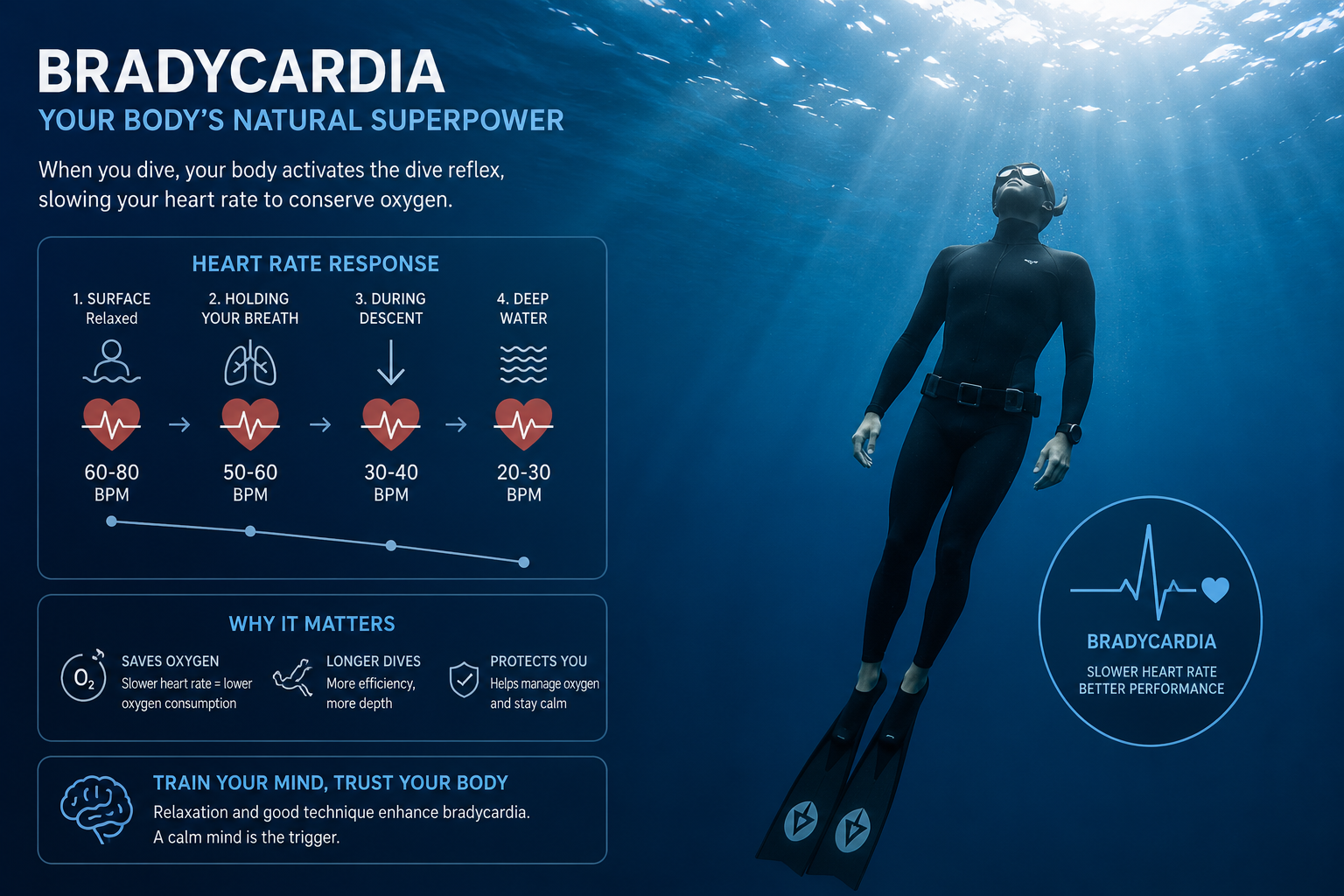
As we discussed in the previous article, one component of the Mammalian Dive Reflex is bradycardia. Your heart gradually slows. Less oxygen is consumed. More remains available for the organs that need it most. This response isn’t dramatic all at once. It develops progressively as your dive continues.
Your Blood Changes Direction
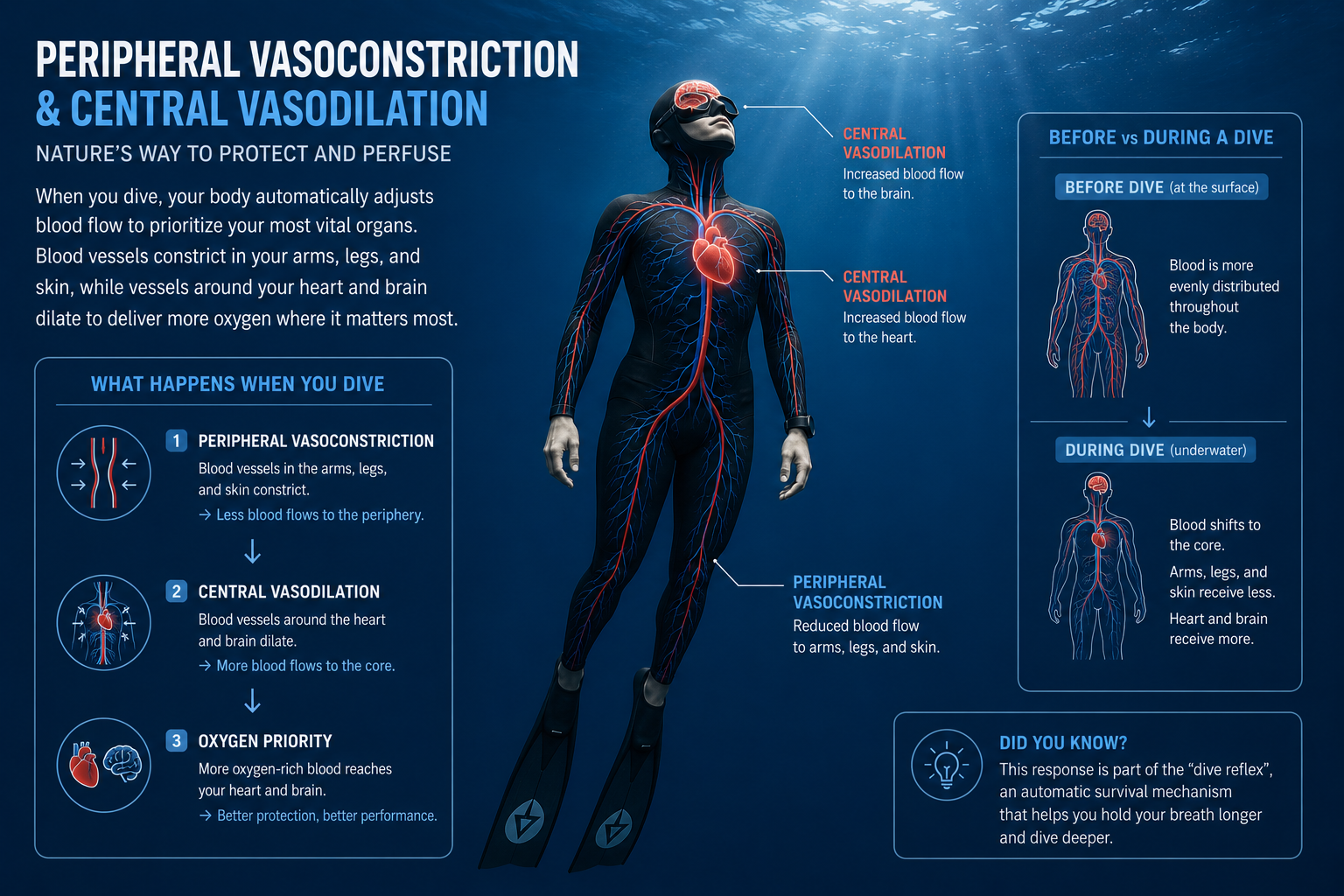
As depth increases, your body becomes remarkably selective about where blood flows. Blood vessels supplying the arms and legs narrow. Meanwhile, blood flow to the brain and heart remains protected. This process, called peripheral vasoconstriction and central vasodilation, helps conserve oxygen where it’s matters most. It’s an elegant example of biological efficiency.
Blood Shift: Protecting the Lungs
One of the most fascinating adaptations happens much deeper. As the lungs continue compressing, blood gradually moves into the tiny vessels surrounding them. This is known as blood shift. Many people imagine blood shift as filling the lungs with blood. That’s not really what’s happening. The blood moves into the pulmonary circulation, helping support the lung tissue against increasing external pressure. Without this adaptation, deep freediving would be much more difficult.

Your Mind Changes Too
The deeper you go… The quieter everything often becomes. Sounds fade. Movement slows. Many divers describe an incredible sense of calm during freefall. I certainly do. It’s difficult to explain to someone who has never experienced it. The deeper sections of a dive often become surprisingly peaceful. Not because the environment is becoming easier. But because everything unnecessary gradually disappears.
Oxygen Is Becoming Precious
Throughout the dive, your body is carefully managing a limited oxygen supply. Every unnecessary movement costs energy. Every unnecessary muscle contraction consumes oxygen. That’s why experienced freedivers often appear so relaxed. They’re not conserving effort because they’re lazy. They’re conserving oxygen because it’s valuable.
Coach’s Tip: The deeper you dive, the more valuable smooth technique becomes. Efficiency allows your physiology to do its job.
The Return to the Surface
Eventually every dive changes direction. As you ascend… Pressure decreases. The lungs begin expanding again. Your buoyancy increases. Your heart gradually returns toward its normal rhythm. The dive reflex slowly fades. The body transitions back toward everyday physiology. It’s another remarkable example of how quickly humans adapt.
Your Body Is Always Looking for Balance
One thing I’ve learned over years of diving is that the body constantly seeks equilibrium. Pressure changes. It adapts. Oxygen decreases. It conserves. Carbon dioxide rises. It communicates. Nothing is random. Everything has a purpose. Understanding those adaptations makes freediving feel much less mysterious.
From My Experience: Understanding the body’s adaptations removes a lot of unnecessary fear. Knowledge builds confidence.
Respect the Adaptation
Sometimes people hear about these physiological responses and think: “Great, my body can handle anything.” No. The body is adaptable. Not invincible. Those adaptations work remarkably well within their limits. That’s why proper training, gradual progression and good safety practices remain essential. Nature has given us extraordinary tools. Our responsibility is to use them wisely.

My Perspective
One of the reasons I still enjoy deep diving after so many years is that I never stop being amazed by what the human body can do. Every descent reminds me that we’re not fighting pressure. We’re adapting to it. The ocean isn’t testing us. It’s simply asking us to understand its rules. The better we understand those rules… The more effortless freediving becomes.
Five Amazing Facts About Pressure
- The greatest relative pressure change happens in the first 10 meters.
That’s why equalization becomes so important near the surface.
- Your lungs become progressively smaller throughout the dive.
That’s perfectly normal.
- Your heart naturally slows.
Your body immediately begins conserving oxygen.
- Blood circulation changes.
Oxygen is prioritized for your brain and heart.
- The deeper you go…
The more efficiency matters.
Force becomes less important than relaxation.
Frequently Asked Questions
Why do my lungs get smaller underwater?
Because increasing pressure compresses the air inside them according to Boyle’s Law.
What is blood shift?
Blood shift is the movement of blood into the pulmonary circulation during deep dives, helping support lung tissues against increasing pressure.
Why do I become negatively buoyant?
As your lungs compress, they contain less air, reducing your buoyancy.
Does the heart always slow down?
Yes. Bradycardia is a natural part of the Mammalian Dive Reflex, although its strength varies between individuals and conditions.
Is pressure dangerous?
Pressure itself isn’t dangerous when respected. Problems arise when divers descend beyond their training or fail to equalize properly.
Final Thoughts
One of the most beautiful things about freediving is that the deeper you go, the more you realize you’re not conquering nature. You’re collaborating with it. Every adaptation we’ve explored— Your slowing heartbeat. Your shifting blood. Your compressing lungs. Your changing buoyancy. They’re all reminders that the human body wasn’t designed to resist pressure. It was designed to respond to it. That doesn’t make us marine mammals. But it does reveal something extraordinary.
Hidden beneath our everyday lives is a physiology capable of adapting to an environment that most people never experience. Every dive is a reminder of that hidden potential. And perhaps that’s why I never get tired of descending into the blue. Because every descent is another opportunity to witness just how remarkable the human body really is.