

Why CO₂ Makes You Want to Breathe (And Why That’s Actually a Good Thing)
If you’ve never studied freediving physiology, here’s a question for you. Why do you eventually feel the need to breathe? Most people answer immediately: “Because I’m running out of oxygen.” It’s a perfectly logical answer. It’s also mostly wrong.
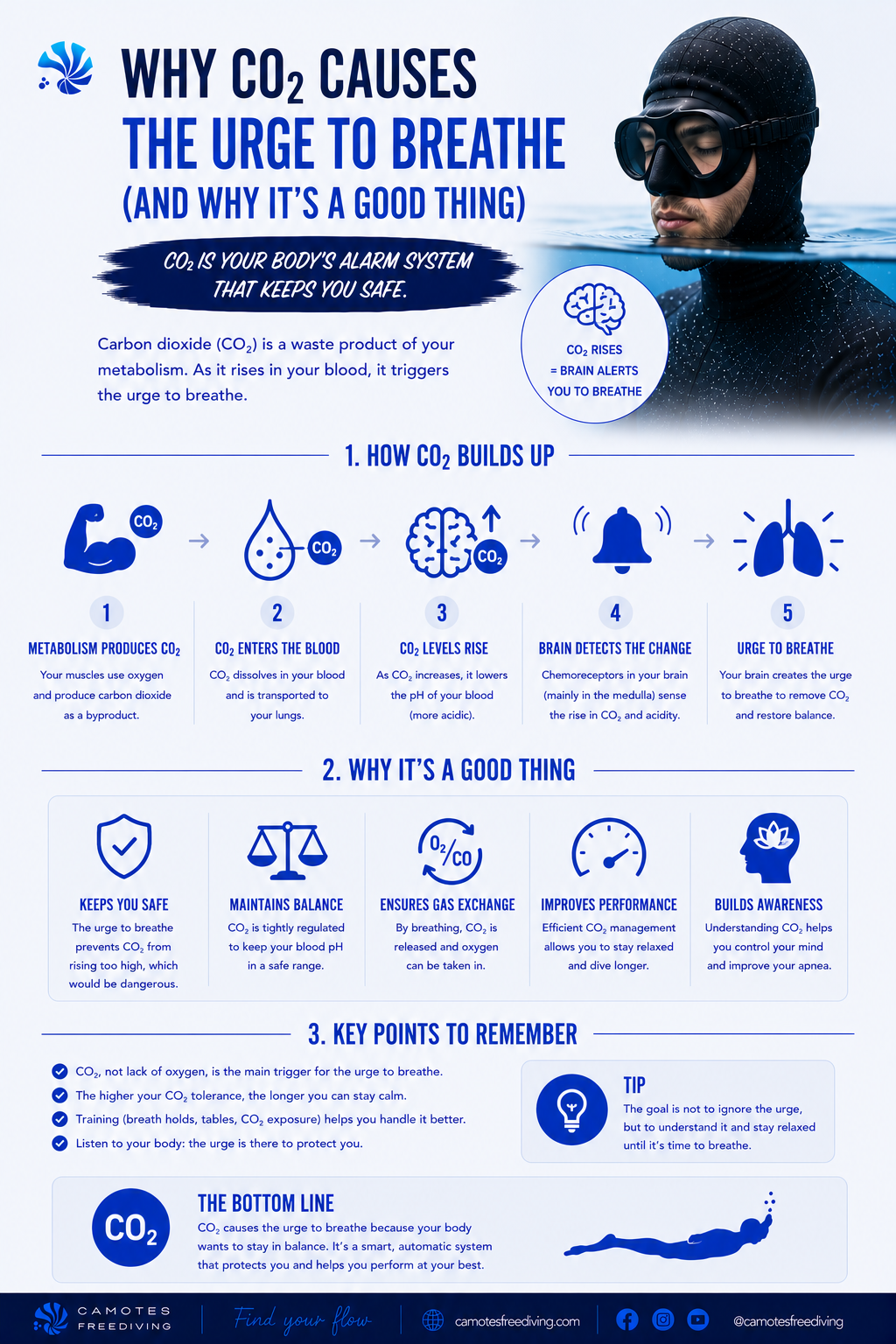
One of the biggest surprises for beginners is discovering that the urge to breathe usually has very little to do with oxygen. Instead… It’s driven primarily by carbon dioxide (CO₂). Understanding this single concept completely changes the way you think about breath-holding. And in my opinion, it’s one of the most important lessons every freediver should learn.
How Long Can the Average Person Hold Their Breath
Oxygen and Carbon Dioxide Are Different Stories
When we breathe, two important things happen. We take in oxygen. We eliminate carbon dioxide. Most people naturally focus on oxygen because it sounds more important. After all… We can’t live without it. But your brain is constantly monitoring something else as well. CO₂.
As your cells produce energy, they generate carbon dioxide as a waste product. That CO₂ gradually accumulates in your blood until you exhale. Holding your breath interrupts that process. The oxygen decreases slowly. The CO₂ rises continuously.
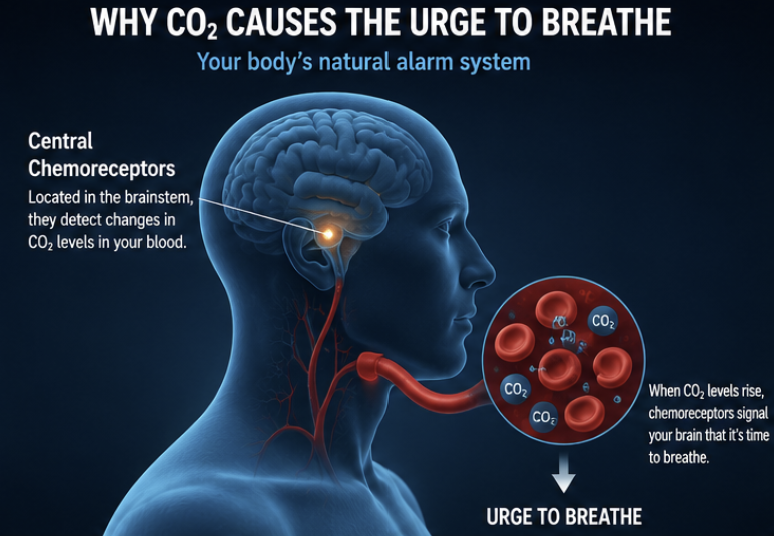
Your Brain Doesn’t Like Rising CO₂
Imagine cooking in your kitchen. Every minute, more steam fills the room. At first… You barely notice it. Gradually… The room becomes warmer. More humid. Less comfortable. Eventually, you open a window. Not because you’ve run out of air. Because the environment has changed. CO₂ works similarly. Your body senses the increasing concentration. When it reaches a certain level, your brain sends a message. “It’s time to breathe.” That message is the urge to breathe.

The Urge to Breathe Is a Safety Mechanism
Many beginners think the urge to breathe is the enemy. Actually… It’s one of your greatest allies. The urge arrives long before oxygen becomes dangerously low in most normal situations. It’s your body’s early warning system. It encourages you to breathe before things become critical. Without it, humans would be remarkably poor at surviving. So rather than trying to “fight” the urge… Freedivers learn to understand it.
What Do Contractions Mean?
Sooner or later, every freediver experiences contractions. For beginners, they can be surprising. Sometimes even frightening. Your chest begins moving involuntarily. Your body seems to be trying to breathe on its own. These contractions are not a sign that you’re immediately running out of oxygen. They’re another response to rising CO₂. They’re your respiratory muscles saying: “We’re ready whenever you are.” With experience, most freedivers learn that contractions are simply another stage of the breath hold—not a reason to panic.
Why Beginners Panic
The first time someone experiences contractions, they often think: “Something is wrong.” The heart rate increases. The body becomes tense. The breath hold ends. Not because the contractions were dangerous. Because they were unfamiliar. Education changes everything. Once students understand what contractions are… They usually become much easier to accept.
Training Changes Your Relationship With CO₂
One of the remarkable adaptations in freediving is that your relationship with CO₂ changes. Notice I didn’t say you stop producing CO₂. You don’t. Your body still works exactly the same way. What changes is your perception. With experience, the rising CO₂ becomes less alarming.
You remain calmer. The urge to breathe becomes something you observe rather than something you fear. That’s a huge difference.
CO₂ Isn’t the Enemy
This is something I emphasize constantly during courses. People often talk about building “CO₂ tolerance.” Sometimes that phrase creates the wrong impression. The goal isn’t to ignore your body. The goal is to understand it. CO₂ isn’t trying to stop you from diving. It’s communicating with you. The better you understand that communication… The more relaxed you become.


Relaxation Changes Everything
Have you ever noticed that some breath holds feel much easier than others? Often the difference isn’t physiology. It’s psychology. If you’re relaxed… Your muscles consume less oxygen. You produce CO₂ more slowly. Your breathing urge arrives later. The body becomes remarkably efficient. That’s another reason why relaxation is one of the greatest performance tools available to any freediver.
Why Hyperventilation Is Dangerous
This is perhaps the most important section of this article. Some people believe taking many fast breaths before diving helps them hold their breath longer. Technically… It often does. But not for the reason they think. Hyperventilation removes large amounts of CO₂. Remember… CO₂ is what creates the urge to breathe.
If you artificially lower CO₂, you’ve essentially delayed your warning system. Your oxygen continues falling normally. But your brain no longer receives its usual signals. This dramatically increases the risk of hypoxic blackout. That’s why responsible freediving education strongly discourages hyperventilation. You haven’t increased your oxygen reserves. You’ve simply silenced your alarm.
Why You Should Never Hyperventilate Before Freediving
The Goal Isn’t a Bigger CO₂ Tolerance
People sometimes ask me: “How can I dramatically increase my CO₂ tolerance?” My answer usually surprises them. Instead of chasing discomfort… Learn relaxation. Improve your technique. Reduce unnecessary effort. Those changes naturally improve your breath holds without trying to overpower your physiology. The body rewards efficiency. Not suffering.
My Own Perspective
When I first started freediving, I thought the urge to breathe meant I was approaching my absolute limit. Now I see it very differently. It’s information. Nothing more. A conversation between my body and my brain. Sometimes the message is gentle. Sometimes stronger. Either way… It’s simply feedback. Learning to listen instead of fear it completely changed the way I approach breath-holding.

Five Things Every Freediver Should Remember
- CO₂ usually creates the urge to breathe—not low oxygen.
Understanding that changes everything.
- Contractions are normal.
They’re part of the body’s communication system.
- Relaxation slows CO₂ production.
The calmer you are, the more efficiently you use oxygen.
- Never hyperventilate before freediving.
Reducing your urge to breathe without increasing oxygen is dangerous.
- Respect your body’s signals.
Freediving isn’t about ignoring physiology. It’s about understanding it.
Frequently Asked Questions
Does low oxygen make you want to breathe?
Not usually. During normal breath holds, the urge to breathe is driven primarily by rising CO₂ levels rather than falling oxygen.
What causes diaphragm contractions?
Diaphragm contractions are an involuntary response to increasing CO₂ and are part of the body’s natural breathing drive.
Can you train your CO₂ tolerance?
Yes, but the goal is not to ignore your body’s signals. Proper training improves comfort with rising CO₂ while always respecting safe limits.
Is hyperventilation before diving dangerous?
Yes. Hyperventilation lowers CO₂ without significantly increasing oxygen, delaying the urge to breathe and increasing the risk of shallow water blackout.
Why do experienced freedivers seem so calm during contractions?
Because they understand what the contractions mean. Experience replaces fear with knowledge, allowing them to remain relaxed rather than reacting emotionally.
Final Thoughts
One of the greatest lessons freediving has taught me is that not every uncomfortable sensation is an emergency. The urge to breathe feels powerful. It demands attention. But it’s not your body failing. It’s your body communicating. For me, that shift in perspective was transformative. I stopped seeing my physiology as something to fight. I started seeing it as something to understand. And the more I listened… The more relaxed I became. Perhaps that’s the real lesson behind carbon dioxide. It’s not an obstacle standing between you and deeper dives. It’s a remarkably intelligent messenger that has helped humans survive for millions of years. The goal isn’t to silence that messenger. The goal is to understand what it’s trying to tell you. When you do… Breath-holding becomes less of a battle. And much more of a conversation.


